
Quick Answer: To prepare sodium taurodeoxycholate (CAS 1180-95-6) solutions, weigh powder quickly in a low-humidity area, dissolve in cold or room-temperature deionized water with gentle stirring (avoid foaming), adjust to your protocol pH if required, then filter-sterilize or aliquot for storage. Use the COA formula weight for hydrate lots. Target concentrations below are literature starting ranges — validate with your SOP.
Before You Weigh: Moisture & Safety
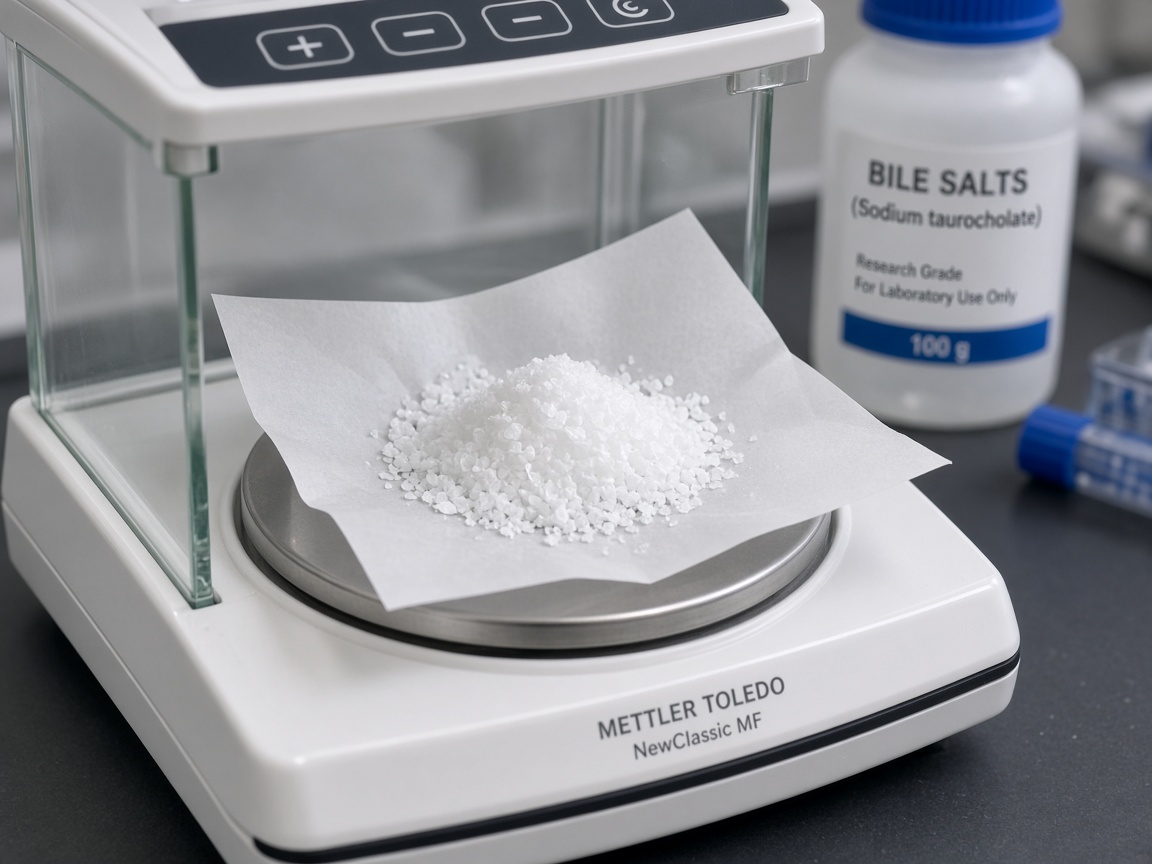
STDC powder is moderately hygroscopic. Equilibrate the closed bottle to room temperature, work fast, and reseal immediately. Wear gloves and eye protection (GHS irritation profile). Full storage guidance: Bile Salt Powder Storage & Moisture.
Molarity Calculation
Mass (g) = Molarity (M) × Volume (L) × Formula weight (g/mol).
| Target stock | Example mass for 50 mL | Notes |
|---|---|---|
| 10 mM | Use FW from COA × 0.01 × 0.05 | Common working-stock starting point |
| 50 mM | Scale linearly | Ensure solubility at your temperature |
| 100 mM | Scale linearly | Warm slightly only if SOP allows; do not overheat |
| 0.5 M (literature max ~0.5 M at 20 °C) | High concentration — verify clarity | Filter if particulates appear |
If the catalog lists sodium taurodeoxycholate hydrate, use the batch-specific formula weight — not the anhydrous 521.7 g/mol alone.
Step-by-Step Preparation
- Calculate required mass from COA formula weight and desired molarity.
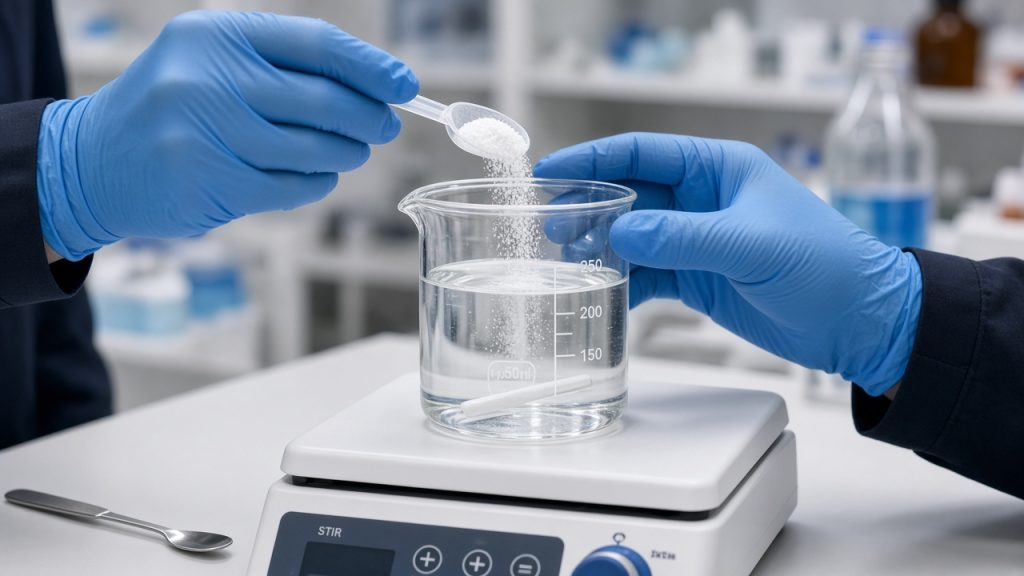
- Add 70–80% of final volume water to a clean beaker or tube.
- Add STDC powder while stirring slowly; avoid vigorous vortexing at high concentration.
- Once dissolved (clear to faint yellow), bring to final volume.
- Adjust pH per protocol (many workflows use neutral pH; strong acid may precipitate bile salts).
- Optional: pass through 0.22 µm filter for sterile use; label lot, date, molarity.
- Aliquot to reduce freeze–thaw cycles if storing frozen.
Solubility Troubleshooting
| Issue | Likely cause | Try (validate in SOP) |
|---|---|---|
| Cloudy solution | Insufficient mixing, particulates, or hard water | Extend stir time; use high-quality water; filter |
| Yellow tint | Common at high mM; may deepen with age | Prepare fresh if assay sensitive to color |
| Precipitate after pH drop | Bile salt insolubility at low pH | Titrate carefully; buffer near neutrality |
| Lower than expected molarity | Hydrate water not accounted for | Recalculate with COA FW |
Dilution to Working Concentration
C₁V₁ = C₂V₂ for serial dilution from stock. For assay-specific ranges see Typical Concentrations for Cell & Membrane Assays. Order STDC (CAS 1180-95-6) with COA for lot traceability.
FAQ
Should I use water or buffer to dissolve STDC?
Most protocols dissolve in water first, then dilute into working buffer. Follow the primary reference for your protein or cell assay.
Do I need to sonicate?
Usually gentle stirring suffices. Sonication is rarely required and may introduce heat or aerosol — use only if your SOP specifies.
Can I autoclave STDC solutions?
Autoclaving is generally not recommended for detergent solutions; use filter sterilization when sterility is required.
How long is a stock solution stable?
Depends on concentration, pH, light exposure, and storage. Store protected from light; see Storage & Moisture. Prepare fresh for critical assays when in doubt.
What if my bottle is clumpy?
May indicate moisture uptake. Inspect lot integrity; contact supplier for replacement if out of spec. Do not assume original purity if degradation is suspected.
Related Resources
- Typical Concentrations for Assays
- Storage & Moisture Control
- What Is Sodium Taurodeoxycholate?
- Sodium Taurodeoxycholate / Taurodeoxycholic acid sodium salt (CAS 1180-95-6)
- Biochemistry Workflow
- Specs Buyers Ask
Disclaimer
This article is for research and laboratory use information only. It does not constitute medical, diagnostic, or therapeutic advice. Verify all concentrations, grades, and handling steps against your institution’s SOP, SDS, and primary literature before use in regulated or clinical-adjacent workflows.