

Quick Answer: Buyers and QA teams routinely ask for CAS 1180-95-6 identity, HPLC purity, formula weight / hydration, optical rotation, solubility confirmation, SDS, and retest/storage conditions on the Certificate of Analysis (COA) for taurodeoxycholic acid sodium salt. Match specs to use case: membrane protein R&D vs cell culture vs pharma research.
Core Specification Table
| Parameter | Typical spec (research grade) | Notes |
|---|---|---|
| CAS No. | 1180-95-6 | Non-negotiable identity anchor |
| Chemical name | Sodium taurodeoxycholate / TDCA-Na | Include on PO and COA |
| Molecular formula | C₂₆H₄₄NNaO₆S | Hydrate forms add H₂O in FW |
| Molecular weight | ~521.7 g/mol (anhydrous basis) | Use COA value for calculations |
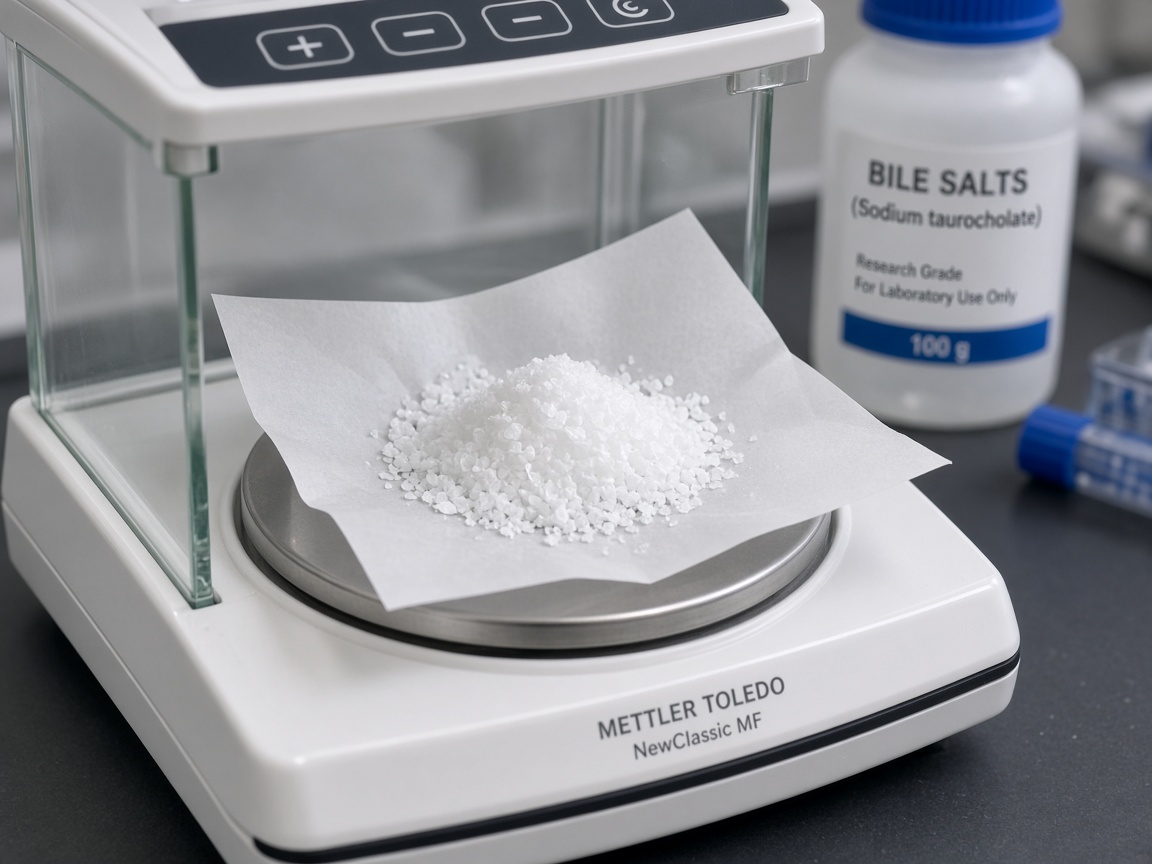
| Appearance | White to off-white crystalline powder | Clumps may indicate moisture exposure |
| Purity (HPLC) | ≥97–98% common; ≥95% standard grade | State grade on PO |
| Optical rotation | [α]≈ +33° (c=3, water) (literature) | Lot-specific on COA |
| pKa | ~1.9 (sulfonic acid group) | Explains acid pH precipitation risk |
| Water solubility | Up to ~0.5 M at 20 °C (supplier data) | Clear, faint yellow possible |
| Melting point | ~168 °C (dec.) | Thermal decomposition, not sharp melt |
Hydrate Disclosure
If the SKU is sodium taurodeoxycholate hydrate, the COA should state formula weight or water content. Purchasing should flag hydrate SKUs to the lab so molarity calculations stay consistent.
Application-Specific Spec Modules
| Use case | Extra specs to request | Why |
|---|---|---|
| Membrane protein solubilization | HPLC purity ≥97–98%; identity tests | Minimize detergent artifacts |
| Cell culture / signaling | Endotoxin; sterile-filtered option | Bioassay interference |
| Pharma / API research | Elemental impurities; stability data | Regulatory-adjacent documentation |
| Long-term program | Retest date; storage under inert gas | Inventory planning |
Safety & Regulatory Lines on COA / SDS
- GHS07 — skin, eye, respiratory irritation (research handling with PPE)
- EINECS 214-652-0 commonly cited
- UNII 5PE424S83L for cross-database search
- Not classified as dangerous goods for transport (typical supplier statement — verify SDS)
Questions to Email Your Supplier
- Send COA for current lot before PO approval.
- Confirm hydrate status and exact formula weight.
- Clarify cell-culture or endotoxin testing if needed.
- Ask pack size and lead time (MOQ from 50 g; kg bulk for production).
- Request SDS revision date matching shipment.
Ready to order? STDC product page (CAS 1180-95-6).
FAQ
What purity do published membrane protocols expect?
Many assume research-grade HPLC ≥97% or higher — specify on your PO.
Is optical rotation required?
Useful as a secondary identity check when listed; not every lab tests in-house.
Do you provide TDS?
Reputable suppliers provide TDS + SDS + COA — archive all three in your quality system.
What if COA purity is borderline?
Do not release to critical work without QA decision; request replacement lot or upgraded grade.
Related Resources
- Buying Guide: Purity, Hydrate & COA
- Sodium Taurodeoxycholate / Taurodeoxycholic acid sodium salt (CAS 1180-95-6)
- Storage & Moisture
- Solution Preparation
- Contact Monuo
Disclaimer
This article is for research and laboratory use information only. It does not constitute medical, diagnostic, or therapeutic advice. Verify all concentrations, grades, and handling steps against your institution’s SOP, SDS, and primary literature before use in regulated or clinical-adjacent workflows.