
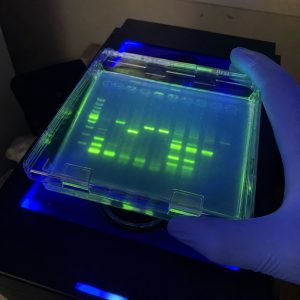
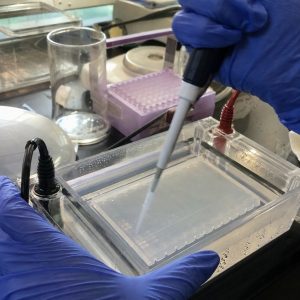
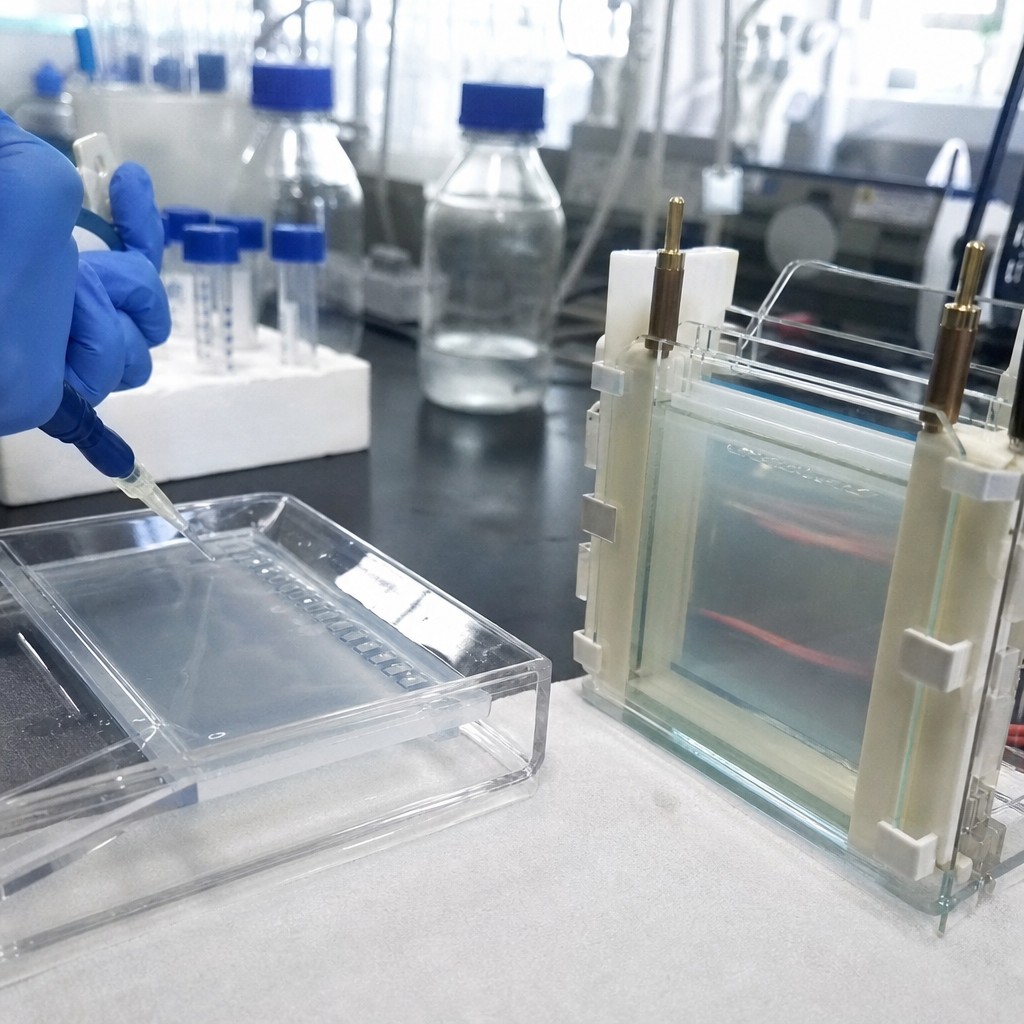
Quick Answer: For nucleic acid electrophoresis, choose agarose when you need a fast, forgiving gel for larger DNA/RNA fragments (roughly ~50 bp to tens of kb, depending on % and method). Choose polyacrylamide gel electrophoresis (PAGE) when you need higher resolution for smaller fragments (often <500 bp, and especially <100 bp) or when a validated SOP already specifies PAGE. Agarose is cast from agarose powder (CAS 9012-36-6) dissolved in buffer; PAGE is cast from acrylamide/bis-acrylamide monomers. They solve different separation problems — not interchangeable defaults.
Why Labs Ask “Agarose or PAGE?”
The question usually appears when a gel looks “wrong”: bands too smeared on agarose, or a method demands single-base resolution that agarose cannot deliver. The fix is often method selection, not switching brands of the same gel type.
If you are still defining the agarose side of the workflow, start with Agarose (CAS 9012-36-6): What It Is, How Gel Electrophoresis Works & How to Choose Powder. This article answers the cross-method decision: agarose gel vs polyacrylamide.
What Agarose and PAGE Actually Are
| Gel type | Matrix material | Typical casting | Primary lab role |
|---|---|---|---|
| Agarose gel | Neutral polysaccharide powder (CAS 9012-36-6) | Heat to dissolve powder in TAE/TBE; cool to set | Routine DNA/RNA size checks, cloning QC, teaching labs |
| Polyacrylamide gel (PAGE) | Acrylamide + bis-acrylamide polymerized in situ | Chemical polymerization; often precast or hand-cast | Fine resolution of small DNA/RNA; sequencing ladders; oligo QC |
Note: “PAGE” also includes SDS-PAGE for proteins — a different workflow (denaturing protein separation). This guide focuses on nucleic acid agarose vs polyacrylamide. If your SOP says “PAGE” for DNA, it usually means native or denaturing polyacrylamide for nucleic acids, not SDS-PAGE.
Agarose vs PAGE: Side-by-Side Comparison
| Topic | Agarose gel | Polyacrylamide (PAGE) |
|---|---|---|
| Best fragment window (DNA, practical) | ~50 bp – ~25 kb (depends strongly on %) | Often best below ~500 bp; strong for <100 bp |
| Resolution | Good for routine size checks; limited for very small fragments | High — can separate fragments differing by a few bp |
| Casting difficulty | Low — heat, pour, cool | Higher — monomers, polymerization, toxicity handling |
| Run time (typical) | Often faster for routine analytical gels | Can be longer; depends on % and voltage |
| Sample recovery | Easy with standard or LMP agarose protocols | Possible but more fiddly; smaller yield for tiny fragments |
| Safety / EHS | Powder handling; stain waste management | Acrylamide monomer exposure rules; PPE and waste streams |
| Cost per gel (typical lab) | Lower for high-throughput PCR checks | Higher setup; justified when resolution demands it |
| Teaching / shared cores | Default first choice for DNA labs | Specialized benches or named SOPs |
When to Use Agarose Gel Electrophoresis
Choose agarose when your workflow matches these patterns:
- Routine PCR verification — “Did the reaction work? What size?”
- Restriction digest checks and plasmid / genomic fragment sizing in the hundreds of bp to multi-kb range
- Teaching laboratories and high-throughput analytical gels where speed and simplicity matter
- DNA recovery from a gel slice (standard or low-melting agarose)
- RNA integrity screening on denaturing agarose (formaldehyde or similar SOP) for broad size assessment
- Southern / northern blot workflows that historically specify agarose as the separation matrix
Source agarose powder identified as CAS 9012-36-6 from the Agarose (CAS 9012-36-6) product page. Lock gel %, buffer (see TAE vs TBE for agarose gels), and voltage in the SOP.
When to Use Polyacrylamide Gel Electrophoresis (PAGE)
Choose PAGE when resolution requirements exceed what agarose can deliver:
- Small DNA fragments — microsatellites, CRISPR amplicons, deletion assays where band spacing matters below ~500 bp
- Oligonucleotide QC and short synthetic DNA analysis
- Sequencing ladders and fragment-length standards that need sharp, evenly spaced bands
- Single-base resolution or near-single-base resolution (e.g., some mutation-detection formats on polyacrylamide)
- Denaturing PAGE for RNA or DNA when secondary structure would distort migration on agarose
- Validated regulatory or core-facility SOPs that explicitly name polyacrylamide — do not substitute agarose silently
PAGE does not replace agarose for everyday cloning QC. It complements it as the high-resolution tool for smaller fragments.
Fragment Size: Practical Decision Table
| Approx. DNA size range | First gel to try | Why |
|---|---|---|
| >10 kb | Low % agarose (e.g. 0.7%) | Pore size suited to large fragments; PAGE rarely used here |
| 0.5–10 kb | 1.0–1.5% agarose | Default molecular biology window; fastest daily workflow |
| 100–500 bp | 1.5–2.0% agarose or PAGE | Agarose may suffice for rough checks; PAGE if bands must be sharply resolved |
| <100 bp | PAGE (often higher %) | Agarose pore size often too large for reliable small-fragment separation |
| Single-base differences | Denaturing PAGE or specialized format | Beyond routine agarose capability |
Ranges are illustrative. Always validate against your ladder, instrument, and institutional SOP.
Native vs Denaturing: Both Gel Types Offer Options
| Format | Agarose example | PAGE example | Typical use |
|---|---|---|---|
| Native | Standard TAE/TBE agarose | Native polyacrylamide | Size separation under non-denaturing conditions |
| Denaturing | Formaldehyde / denaturing agarose for RNA | Urea or denaturing PAGE | Reduce secondary structure; sharper RNA/DNA sizing |
Denaturing conditions change migration — they do not change the agarose vs PAGE size-window logic. Pick gel chemistry from the validated method first.
Casting and Operational Differences Buyers Should Know
Agarose workflow (summary)
- Weigh agarose powder → add buffer → heat until clear → cool → cast
- Buffer choice (TAE vs TBE) affects run behavior — standardize one system
- Failures often trace to incomplete dissolution, wrong %, or exhausted buffer
- Recovery workflows may require LMP agarose — see Standard vs LMP Agarose (CAS 9012-36-6 vs 39346-81-1) for grade selection separate from the agarose-vs-PAGE decision.
PAGE workflow (summary)
- Prepare acrylamide/bis solution → pour between plates or use precast cassettes → polymerize
- Handle monomer waste per institutional EHS — not equivalent to pouring agarose
- Higher skill barrier; more batch-to-batch variability if hand-cast
- Precast systems trade cost for reproducibility — common in cores and regulated labs
Decision Guide for Lab Managers and Purchasing
| Situation | Standardize on | Procurement note |
|---|---|---|
| Daily PCR / plasmid QC | Agarose (CAS 9012-36-6) | Stock 1.0% and 1.5% recipes; one buffer system |
| Core facility teaching rotation | Agarose first; PAGE in advanced module | Separate training and waste streams for PAGE |
| Short-fragment assay with tight specs | PAGE per SOP | Do not downgrade to agarose without method revalidation |
| Gel extraction for cloning | Agarose or LMP agarose | PAGE recovery is secondary unless SOP requires it |
| New lab startup kit | Agarose powder + ladders + one buffer system | Add PAGE capability when projects require it |
Common Mistakes When Switching Between Gel Types
- Using agarose for sub-100 bp work and blaming “bad powder” when the matrix is wrong for the size window
- Using PAGE for every PCR check — slower, costlier, and unnecessary for routine QC
- Mixing ladder types — ladders are validated for specific gel chemistries
- Ignoring denaturing requirements on structured RNA/DNA
- Silent SOP drift — agarose bench pours PAGE, or vice versa, without documentation
What to Put on the SOP and RFQ
For agarose methods, lock:
- CAS 9012-36-6 (or LMP CAS if recovery SOP requires it)
- Gel % w/v, buffer system, voltage/time limits
- Stain type and imaging settings
For PAGE methods, lock:
- Acrylamide % and cross-linker ratio (e.g., 6%, 12%, 20%)
- Native vs denaturing chemistry
- Precast vs hand-cast specification
Evaluating agarose powder while you map which projects need PAGE? Request a 5–20 g sample + COA for Agarose CAS 9012-36-6 via Request a Quote or [email protected].
FAQ
Is agarose or PAGE better for DNA electrophoresis?
Neither is universally better. Agarose is the default for routine DNA sizing from roughly tens of bp up to multi-kb. PAGE is better when you need high resolution for small fragments, especially below ~500 bp.
Can agarose separate 50 bp fragments?
Sometimes at high agarose % (e.g., 2–3%), but resolution is limited compared with PAGE. If your assay depends on sharp separation of small fragments, validate PAGE rather than pushing agarose to its edge.
What is the smallest DNA size agarose can resolve?
Practical limits depend on gel %, buffer, and imaging. Many labs treat <100 bp as the zone where PAGE becomes the more reliable first choice.
Does PAGE replace agarose in a molecular biology lab?
No. Most labs run agarose daily and use PAGE for specific high-resolution applications. Both coexist in a typical workflow.
Is SDS-PAGE the same as DNA PAGE?
No. SDS-PAGE denatures and separates proteins by size. DNA PAGE uses polyacrylamide under native or denaturing nucleic acid conditions — different sample prep, buffers, and interpretation.
When should I buy LMP agarose instead of standard agarose?
When your agarose SOP requires in-gel recovery or heat-sensitive enzymatic steps — not because you chose PAGE. See Standard vs LMP Agarose comparison.
Where can I source electrophoresis agarose (CAS 9012-36-6)?
Monuo Chemical supplies standard Agarose (CAS 9012-36-6) and low gelling temperature agarose (CAS 39346-81-1). Contact: Request a Quote · [email protected].
Conclusion
Use agarose — cast from CAS 9012-36-6 powder — for fast, routine nucleic acid sizing across the common kb range and for most recovery workflows. Use PAGE when the method demands fine resolution of small fragments or when your validated SOP names polyacrylamide. Document the choice in the SOP so benches do not drift between gel types mid-project.
Request a 5–20 g sample + COA of Agarose (CAS 9012-36-6) while you standardize gel-type rules via the contact page.
Related Resources
- Agarose (CAS 9012-36-6) product page
- Agarose Low Gelling Temperature (CAS 39346-81-1) product page
- Agarose guide: electrophoresis and powder selection
- TAE vs TBE for agarose gels
- Standard vs LMP Agarose comparison
- Nucleic acid gel electrophoresis overview
- Nucleic acid electrophoresis troubleshooting
- Agarose essential polysaccharide overview
- Request a Quote / Contact Monuo Chemical
- Monuo Chemical News
Disclaimer: Information is for laboratory method selection and purchasing reference. Protocols are illustrative and must be validated under your institutional SOP, biosafety, and EHS rules — especially for acrylamide handling. Verify agarose lots against the supplied COA and SDS.