

1. Introduction: Why Agarose Matters in Modern Bioscience
If you have ever analyzed DNA in a laboratory — whether for genetic research, clinical diagnostics, or forensic identification — you have almost certainly used agarose. This unassuming white powder, derived from red seaweed, is one of the most widely used reagents in molecular biology. Its ability to form a porous, thermoreversible gel provides the foundation for agarose gel electrophoresis, the standard method for separating and analyzing DNA and RNA fragments by size.
Agarose gels are found in research labs, clinical testing centers, pharmaceutical quality control departments, and teaching institutions around the world. The global market for agarose continues to grow steadily, driven by advances in genomics, personalized medicine, and biotechnology. Yet for all its ubiquity, agarose is often taken for granted — a reagent purchased by catalog without a deep understanding of what makes one grade suitable for one application and not another.
This article takes a first-principles approach to agarose: what it is chemically, how it forms a gel, what the technical specifications really mean, and how to select the right type for your specific application. Whether you are a laboratory technician optimizing an electrophoresis protocol, a procurement professional evaluating suppliers, or a student learning molecular biology techniques, this guide will provide the practical knowledge you need.
2. What Is Agarose? Chemical Identity & Natural Origin
Agarose (CAS 9012-36-6) is a linear polysaccharide extracted from red seaweed species of the genera Gelidium and Gracilaria. It is the purified, neutral fraction of agar — the other fraction being agaropectin, a sulfated polysaccharide. The separation of agarose from agaropectin is critical, as the charged sulfate groups in agaropectin can interfere with electrophoretic separation.
| Property | Value |
| CAS Number | 9012-36-6 |
| INCI Name | Agarose |
| Chemical Classification | Linear polysaccharide |
| Repeating Units | D-Galactose and 3,6-anhydro-L-galactose |
| Typical Molecular Weight | 80,000 – 120,000 Da |
| Source | Red seaweed (Gelidium, Gracilaria) |
The chemical structure of agarose consists of alternating units of β-D-galactose linked by β(1→4) bonds to 3,6-anhydro-α-L-galactose, which are in turn linked by α(1→3) bonds. This repeating disaccharide structure gives agarose its unique physical properties. The absence of charged groups (such as sulfate or carboxyl) in purified agarose is what makes it neutral and suitable for electrophoresis.
Agarose is supplied as a white to off-white free-flowing powder. It is insoluble in cold water but dissolves readily when heated above 90°C. One of its most remarkable properties is its low toxicity and biocompatibility.
3. How Does Agarose Form a Gel? The Thermoreversible Gelling Mechanism
The gelling behavior of agarose is arguably its most important functional property. Understanding how and why it gels helps explain why it is used the way it is in the laboratory.
When dry agarose powder is added to water and heated above approximately 90°C, the polymer chains disperse and exist as random coils in solution. As the solution cools, the chains begin to associate through hydrogen bonding, forming double helices. These helices further aggregate into larger bundles, creating a three-dimensional network of interconnected fibers. The spaces between these fibers form the pores that give the gel its sieving properties.
One of the defining characteristics of agarose gels is thermal hysteresis: the temperature at which the gel forms (the gelling temperature) is significantly lower than the temperature at which it melts (the melting temperature). For standard agarose at a 1.5% concentration, the gelling temperature is typically in the range of 34–38°C, while the melting temperature is in the range of 85–95°C. This hysteresis means that once a gel has set, it remains stable at typical electrophoresis running temperatures.
The pore size of an agarose gel is not fixed; it can be tuned by adjusting the agarose concentration. Higher concentrations produce smaller pores for separating smaller fragments. Lower concentrations produce larger pores for separating larger fragments.
Content Quality Ladder: Understanding Agarose at Different Depths
| Content Depth Level | Example |
| Basic: Name only | “Contains agarose” — no useful information |
| Moderate: Definition | “Agarose is a polysaccharide from seaweed used to make gels” — surface level |
| Good: Mechanism + Application | “Agarose forms a thermoreversible gel via hydrogen bonding; used to separate DNA fragments by size in electrophoresis” — informative |
| Advanced: Specifications + Selection | “Low EEO agarose (below 0.13) is recommended for routine DNA electrophoresis; at 1% concentration it separates fragments from 0.5 to 10 kb” — practical |
| Expert: All above + Original Data | Custom gel strength data, application-specific optimization studies, batch consistency reports — truly differentiated |
4. Key Specifications: What the Numbers Mean
Not all agarose is the same. When evaluating agarose products, you will encounter several technical specifications that determine whether a particular grade is suitable for your application.
Electroendosmosis (EEO)
EEO is a measure of the negatively charged groups (primarily residual sulfate) present in the agarose. During electrophoresis, these fixed negative charges cause a counter-flow of buffer toward the negative electrode, which can slow or distort the migration of DNA samples. Low EEO agarose (typically below 0.13) is preferred for most molecular biology applications. Medium EEO agarose (0.16 to 0.19) may be acceptable for some immunodiffusion techniques.
Gel Strength
Gel strength measures the mechanical rigidity of the gel, usually expressed in grams per square centimeter (g/cm²) at a specified agarose concentration, most commonly 1.0%. Higher gel strength values indicate a firmer gel that is less prone to tearing during handling. For most electrophoresis work, a gel strength of 800 g/cm² or higher at 1.0% is adequate.
Melting and Gelling Temperatures
Standard agarose typically has a gelling temperature between 33 and 42°C and a melting temperature between 85 and 95°C (measured at 1.5% concentration). Low melting point (LMP) agarose is chemically modified to gel at lower temperatures (26 to 30°C) and melt at lower temperatures (60 to 70°C), making it suitable for recovering heat-sensitive samples.
Purity
Molecular biology grade agarose undergoes additional purification to remove nucleases (DNase, RNase), proteases, and other contaminants. Key purity indicators include absence of detectable nuclease activity, low sulfate content, and low UV absorbance at 260 and 280 nm.
5. Primary Applications in Research and Industry
DNA and RNA Gel Electrophoresis
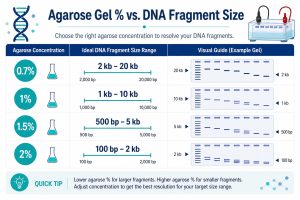
This is by far the most common application of agarose. DNA fragments are separated by size as they migrate through the agarose matrix under an electric field. Typical concentration ranges include:
- 7% agarose: separates DNA fragments from approximately 0.8 to 10 kb
- 0% agarose: separates DNA fragments from approximately 0.5 to 7 kb
- 5% agarose: separates DNA fragments from approximately 0.2 to 3 kb
- 0% agarose: separates DNA fragments from approximately 0.1 to 2 kb
Separated DNA fragments can be visualized under UV light after staining with fluorescent dyes. This technique is fundamental to PCR analysis, restriction enzyme mapping, genotyping, and Southern blotting.
Immunodiffusion and Immunoelectrophoresis
Agarose gels are used as a support medium for immunodiffusion assays, where antigens and antibodies diffuse through the gel and form visible precipitation lines. This technique is used in clinical diagnostics to detect and quantify specific proteins or antibodies.
Chromatography Media
Agarose beads are widely used as the base matrix for size-exclusion chromatography and affinity chromatography in protein purification. They are valued for their high porosity, chemical stability, and low non-specific binding.
Emerging Biomedical Applications
Agarose hydrogels serve as scaffolds for cell culture in tissue engineering, providing a three-dimensional environment that mimics the natural extracellular matrix. Applications include cartilage tissue engineering, nerve regeneration, and wound healing. Agarose is also used as a bioink component in 3D bioprinting.
In microbiology, agarose is used as a solidifying agent in culture media for specialized applications where standard agar might interfere with growth or detection.
6. Agarose Types and How to Choose the Right Grade
Choosing the right agarose for your application can significantly impact your results.
| Type | Key Features | Best For | Considerations |
| Standard Agarose | EEO < 0.13 Gel strength > 800 g/cm² Gelling temp: 34–38°C Melting temp: 85–95°C |
Routine DNA electrophoresis Southern blotting PCR analysis |
Most economical; suitable for most electrophoresis needs |
| Low Melting Point (LMP) Agarose | Gelling temp: 26–30°C Melting temp: 60–70°C EEO < 0.12 |
DNA fragment recovery In-gel enzymatic reactions Heat-sensitive samples |
Higher cost; lower gel strength requires careful handling |
| Low EEO Agarose | EEO < 0.10 High gel strength |
Accurate migration for large fragments Sensitive electrophoresis Pulsed-field electrophoresis |
Premium grade for demanding applications |
| Molecular Biology Grade | Nuclease-free Low UV absorbance Consistent lot-to-lot |
RNA analysis Sequencing library prep Clinical diagnostics |
Highest purity; essential for nucleic acid integrity |
General rule: for routine DNA electrophoresis, standard agarose is usually sufficient. For DNA fragment recovery, choose low melting point agarose. For RNA or sensitive applications, use molecular biology grade.
7. Practical Guide: Preparing and Handling Agarose Gels
Basic Protocol Summary
- Select the appropriate agarose concentration based on the size range of fragments to be separated.
- Mix the agarose powder with the appropriate electrophoresis buffer (typically TAE or TBE) in a flask.
- Heat the mixture until the agarose is fully dissolved and the solution is clear. Avoid prolonged boiling.
- Cool the solution to approximately 55–65°C before pouring the gel into the casting tray.
- Add a fluorescent DNA stain if not pre-staining after electrophoresis.
- Insert the comb and allow the gel to set completely (typically 20–40 minutes at room temperature).
- Place the set gel in the electrophoresis chamber, cover with running buffer, remove the comb, and load samples.
Common Troubleshooting Tips
- Gel too fragile: Increase agarose concentration or switch to a higher gel-strength grade.
- DNA bands smeared: Check for incomplete agarose dissolution, overheating, or degraded DNA samples.
- Uneven migration: Ensure the gel is level during casting and buffer covers the gel uniformly.
- No bands visible: Verify that DNA stain was added and check UV light source.
- Gel melts during run: Reduce voltage or use a higher melting point agarose.
Storage and Shelf Life
Dry agarose powder is stable for several years when stored in a cool, dry environment. Prepared gels can be stored submerged in buffer at 2–8°C for up to one week, though best results are obtained with freshly poured gels.
8. How to Source Agarose: A Practical Checklist
For laboratory managers and procurement professionals, evaluating agarose suppliers requires attention to both product quality and supply chain reliability.
- Certificate of Analysis: Does the supplier provide detailed COAs with actual measured values for EEO, gel strength, melting/gelling temperatures, and purity metrics?
- Batch consistency: Request specification sheets across multiple production lots to evaluate reproducibility.
- Purity documentation: For molecular biology grade, verify that nuclease testing results are provided.
- Particle size and powder flow: Fine powders dissolve faster but may produce more dust.
- Packaging integrity: Agarose is hygroscopic. Ensure packaging protects against moisture.
- Lead time and inventory: Check stock availability for your required grade.
- Customization options: Some suppliers can provide specific EEO ranges or packaging formats for bulk buyers.
9. Frequently Asked Questions
Q1: What concentration of agarose should I use for my DNA samples?
The optimal concentration depends on fragment size. For fragments between 0.5 and 10 kb, 1.0% agarose is a good starting point. Use 0.7% for larger fragments (1–25 kb), 1.5% for smaller fragments (0.2–3 kb), and 2.0% or higher for fragments under 200 bp.
Q2: What is the difference between TAE and TBE buffer for agarose electrophoresis?
TAE (Tris-acetate-EDTA) provides faster migration but lower buffering capacity. TBE (Tris-borate-EDTA) has higher buffering capacity and produces sharper bands for longer runs. Choose TAE for routine analysis and TBE for high-resolution separation.
Q3: Can agarose gels be stored for later use?
Pre-cast agarose gels can be stored submerged in electrophoresis buffer at 2–8°C for up to one week. However, gels gradually dehydrate and lose resolution. For best results, prepare fresh gels on the day of use.
Q4: Is agarose safe to handle in the laboratory?
Yes. Agarose is generally considered non-toxic. However, the powder can irritate the respiratory tract if inhaled, so handle in a well-ventilated area. Standard laboratory PPE (gloves, lab coat, safety glasses) should be worn.
Q5: What is the difference between standard agarose and low melting point agarose?
Low melting point agarose is chemically modified to reduce its gelling temperature to 26–30°C and melting temperature to 60–70°C. This allows DNA fragments to be recovered by gentle heating without denaturation. Standard agarose melts at 85–95°C.
10. Conclusion & Next Steps
Agarose is a deceptively simple material with remarkable properties. From its origins as a natural polysaccharide from red seaweed to its role as an indispensable tool in molecular biology, its thermoreversible gelation, tunable pore size, neutral charge, and biocompatibility make it uniquely suited to applications from routine DNA analysis to advanced tissue engineering.
For laboratory professionals, the key takeaways are: understand your application requirements (EEO, gel strength, melting behavior), match the agarose grade to the need, and evaluate suppliers based on actual quality documentation.
Interested in sourcing high-quality Agarose (CAS 9012-36-6) for your laboratory?
Contact us for detailed product specifications, COA, pricing, and bulk availability.