
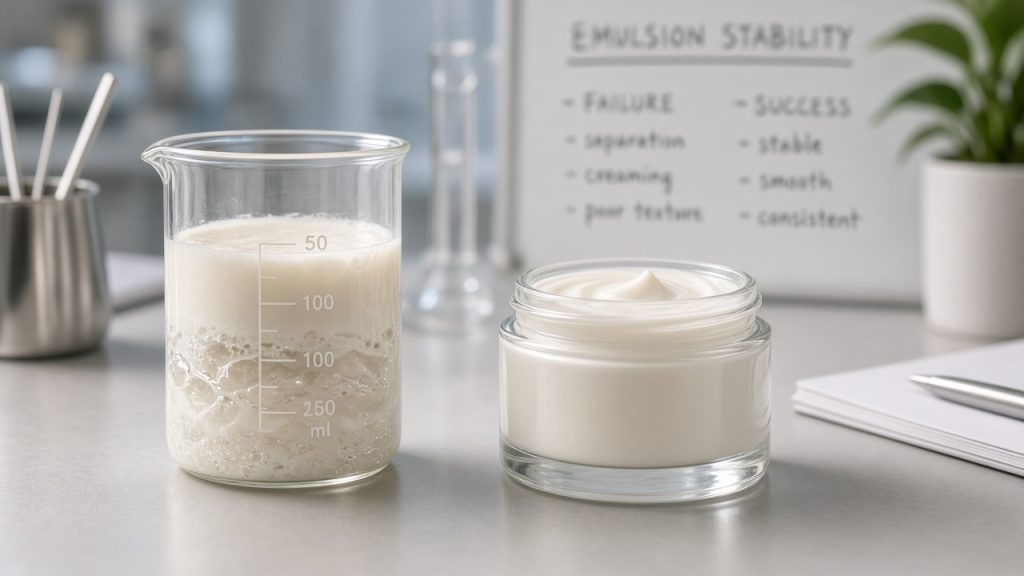
Quick Answer: The most common Syn-Ake emulsion failures — separation, graininess, viscosity drop, or odor drift — usually trace to peptide added too hot, pH out of the mild band, excessive shear after addition, incompatible emulsifier mix, or preservative system stressed by actives. Fix by moving peptide addition to <40 °C cool-down, rechecking HLB and co-emulsifier levels, and running a split batch without peptide to isolate the cause.
Symptom → Likely Cause → Fix
| Symptom | Likely cause | First corrective step |
|---|---|---|
| Phase separation after 1–2 weeks | Peptide added hot; emulsifier imbalance | Rebatch with post-emulsification addition; tune co-emulsifier |
| Grainy texture | Localized peptide precipitation; cold spot gelation | Pre-dilute peptide in humectant; improve mixing homogeneity |
| Viscosity collapse | Anionic/cationic interaction with polymer thickener | Adjust polymer or switch to neutral thickener; see compatibility matrix |
| Yellowing or odor | Oxidation or micro stress | Review antioxidant strategy; micro retest; storage temperature |
| Stinging reports | pH drift low; too many actives at top of range | Recheck pH; reduce conflicting acids; eye vs face format review |
| Foam on filling | High shear after peptide addition | Slow anchor stirrer; de-aerate before fill |
Diagnostic Batch Protocol
- Make a base emulsion control without peptide.
- Make a peptide in water-gel control without oils.
- Combine using approved cool-down SOP from formulating guide
- Run 40 °C / 75% RH and 4 °C samples in parallel.
- Compare pH, viscosity, and appearance at T0, 2, 4, 8 weeks.
Emulsion Design Tips Specific to Peptides
Peptides tolerate many O/W lotions when the oil phase is moderate and the pH stays mild. Problems spike in high-acid or high-alkaline creams and when multiple peptides push total solids — see compatibility matrix.
| Design lever | Recommendation |
|---|---|
| Oil phase load | Moderate; heavy waxes may need stronger emulsifier pairing |
| Thickener | Carbomer + neutralizer timing before peptide; avoid post-add pH shocks |
| Peptide addition | Pre-diluted; slow pour with slow mixing |
| Packaging | Airless preferred for long shelf marketing claims |
FAQ
Can we add Syn-Ake to the water phase before homogenization?
Not recommended if that phase exceeds ~40 °C or sees intense shear. Cool-down addition is safer.
Emulsion broke only in peptide batch — is the lot bad?
Possibly, but first verify addition temperature and pH. Compare against a previous good lot.
Will switching emulsifier fix all peptide instability?
Often helps, but pH and preservative validation must follow any emulsifier change.
Does peptide make emulsions harder to preserve?
Any nutritive aqueous system can stress preservation — run PET on worst-case formula.
Where are use levels for creams documented?
Use levels by format (serum, eye cream, mask).
Should we filter the emulsion after peptide addition?
Only if validated — filters can adsorb peptides or knock out viscosity builders.
Related Resources
- What is Dipeptide Diaminobutyroyl Benzylamide Diacetate (Syn-Ake)?
- The Science Behind Syn-Ake (CAS 823202-99-9)
- Formulating Syn-Ake: Use Level, pH, Cool-Down & Argireline Pairing
- Writing Honest Syn-Ake Claims Language
- Syn-Ake Manufacturing & Quality Control
- Syn-Ake in Expression-Line Cosmetics
- Dipeptide Diaminobutyroyl Benzylamide Diacetate product page (CAS 823202-99-9)
- Cosmetic peptides category
- Contact Monuo Chemical for COA / quotation
- Syn-Ake compatibility matrix
- Working solution preparation
- Raw material storage
Disclaimer
This page is for cosmetic formulation education and B2B sourcing context. Use levels cited are typical literature or supplier-range starting points, not guaranteed recipes. Finished-product claims, labeling, and regulatory compliance remain the customer’s responsibility. Verify each lot against the supplied COA and SDS. Do not use medical, injectable, or drug claim language for topical peptide marketing.