
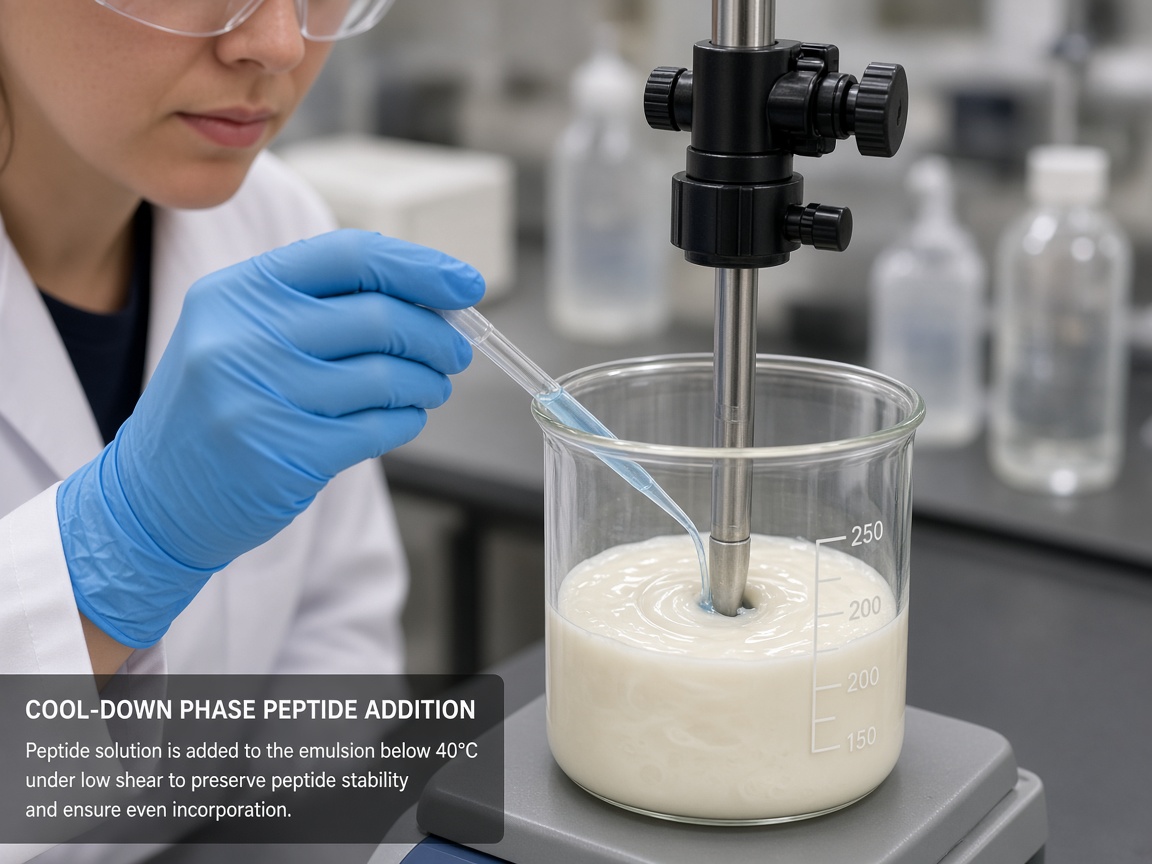
Quick Answer: Typical literature and supplier-range starting points for Syn-Ake (CAS 823202-99-9) vary by format: face serums often discuss ~1–4% of a standard peptide solution; eye creams often use lower apparent levels in the total formula; masks may use similar solution percentages but with shorter contact time in rinse-off types; emulsion creams usually incorporate the peptide post-emulsification at cool-down. These are not fixed recipes — always map to your COA basis and stability data.
Use Levels by Product Format (Illustrative Starting Points)
| Format | Typical supplier/literature discussion | Formulation notes |
|---|---|---|
| Water-based face serum | ~1–4% peptide solution in finished product | Leave-on; pair with HA; mild pH; airless pack preferred |
| Eye cream / eye serum | Often lower than face serum on a total-formula basis | Gentler preservative/blend; avoid irritation stacking with strong acids |
| O/W emulsion cream | Similar solution % as serums when leave-on | Cool-down addition; verify emulsion stability — see troubleshooting guide |
| Sheet mask / hydrogel (leave-on essence) | Moderate solution % possible in essence | Watch fabric saturation and preservative load |
| Rinse-off mask / cleanser | Usually poor value for peptide cost | Contact time limits benefit; marketing rarely justifies use level |
| Multi-peptide booster | Split budget across Syn-Ake + Argireline + others | See Syn-Ake vs Argireline |
Active Basis vs Solution Basis — Do Not Mix Them
A “4% Syn-Ake solution” in a formula is not the same as 4% active peptide. Commercial solutions often contain ~0.5% active peptide in humectant/water. Purchasing, QC, and marketing must use one basis on the BOM and pack copy.
| Documentation item | Recommended practice |
|---|---|
| Master formula | State supplier solution % and calculated active ppm |
| COA folder | Link lot to assay |
| Claim brief | Appearance-only language per product format |
| Stability protocol | Test at lowest and highest planned use level |
Serum vs Eye Cream Positioning
Expression-line serums can emphasize broader face areas; eye products should use copy tuned to the eye area — see expression-line cosmetics article and claims writing guide.
FAQ
What is the maximum Syn-Ake level in a serum?
There is no universal cosmetic maximum — top out where stability, cost, and irritation data plateau for your base.
Can we use the same level in eye cream as face serum?
Often eye products run lower total active load for tolerability; validate with your safety assessment.
Is Syn-Ake meaningful in a rinse-off mask?
Generally limited contact time reduces rationale unless marketing accepts cosmetic storytelling only.
How do multi-peptide products allocate dosage?
Budget total peptide load across INCI list priorities; lead with the peptide your claims support best.
Do masks need different preservatives when peptide is added?
Any change in water activity or actives requires preservative revalidation.
Where are pH and cool-down rules documented?
Formulating Syn-Ake (pH, cool-down, Argireline pairing).
Related Resources
- What is Dipeptide Diaminobutyroyl Benzylamide Diacetate (Syn-Ake)?
- The Science Behind Syn-Ake (CAS 823202-99-9)
- Formulating Syn-Ake: Use Level, pH, Cool-Down & Argireline Pairing
- Writing Honest Syn-Ake Claims Language
- Syn-Ake Manufacturing & Quality Control
- Syn-Ake in Expression-Line Cosmetics
- Dipeptide Diaminobutyroyl Benzylamide Diacetate product page (CAS 823202-99-9)
- Cosmetic peptides category
- Contact Monuo Chemical for COA / quotation
- Syn-Ake vs Argireline comparison
- Compatibility matrix
- Working solution preparation
Disclaimer
This page is for cosmetic formulation education and B2B sourcing context. Use levels cited are typical literature or supplier-range starting points, not guaranteed recipes. Finished-product claims, labeling, and regulatory compliance remain the customer’s responsibility. Verify each lot against the supplied COA and SDS. Do not use medical, injectable, or drug claim language for topical peptide marketing.