

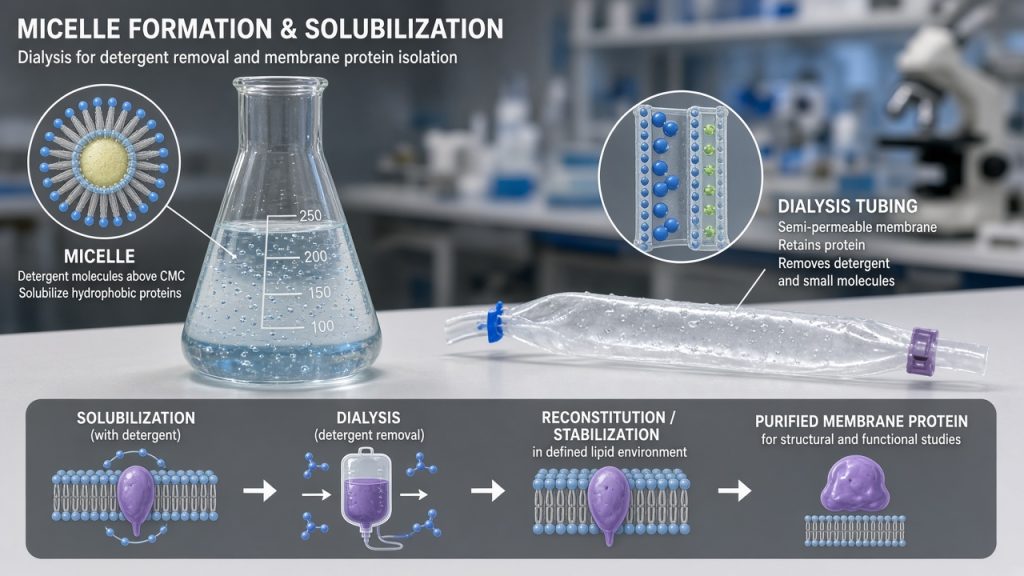
A typical sodium taurodeoxycholate (CAS 1180-95-6) biochemistry workflow moves from membrane isolation → detergent solubilization above CMC → protein capture (chromatography, affinity) → optional detergent exchange or lipid reconstitution into mixed micelles or nanodiscs. STDC forms mixed micelles with phospholipids; concentration and buffer must be validated per target protein.
Workflow Overview
- Prepare reagents: STDC stock, buffers, protease inhibitors (Solution Prep; Storage).
- Isolate membranes or organelles (e.g., mitochondrial fraction).
- Solubilize with STDC at mM above CMC — start with literature range, titrate (Typical Concentrations).
- Clarify lysate; retain supernatant for binding or further purification.
- Purify target protein; monitor detergent carryover.
- Optional: reconstitute into lipid/STDC mixed micelles or exchange to milder detergent.
- Assay activity or submit to structural pipeline per project goals.

Solubilization Decision Table
| Step | STDC role | Starting range (literature) | Monitor |
|---|---|---|---|
| Lysis | Permeabilize membranes | 1–5 mM in some workflows | Protein degradation |
| Primary solubilization | Extract integral proteins | 5–20 mM common window | Yield vs activity |
| Chromatography | Carry detergent through column | Match buffer mM to column SOP | Micelle size shifts retention |
| Reconstitution | Co-micellize with lipid | Protein:lipid:detergent ratio from paper | Functional assay |
Micelles and Mixed Micelles
Above CMC, STDC self-assembles into micelles with hydrophobic interior. When phospholipids are present, mixed micelles form — often essential for native membrane protein function. Compare detergent choice with STDC vs Sodium Taurocholate when designing a gentle ladder.
- Start near reported CMC (~1–3 mM) for pilot, increase if solubilization incomplete
- Avoid unnecessary mM — excess detergent complicates downstream MS and crystallography
- Document temperature: CMC and micelle size are temperature-dependent
Downstream Considerations
| Downstream method | Detergent concern | Mitigation ideas |
|---|---|---|
| Activity assay | STDC may modulate activity | Dialyze, bind resin, or exchange detergent |
| Mass spectrometry | Micelles suppress ionization | Precipitate protein; use MS-compatible surfactants if allowed |
| Crystallography | Strong detergents hinder crystals | Exchange to milder bile salt or non-ionic detergent |
| SPR / binding | Bulk micelles cause signal drift | Optimize Rmax with detergent controls |
Quality Inputs From Purchasing
Use consistent lot, purity, and hydrate form — Buying Guide and Specs Buyers Ask reduce batch-to-batch surprises. Source STDC: Sodium Taurodeoxycholate / Taurodeoxycholic acid sodium salt (CAS 1180-95-6).
FAQ
Is STDC denaturing?
More denaturing than many non-ionic detergents, but milder than some harsh surfactants. Protein-specific — always control with activity gels or assays.
Can I remove STDC completely?
Often partially via binding resin, dialysis (slow), or detergent exchange. Complete removal may cause aggregation of integral membrane proteins.
Why mixed micelles instead of STDC alone?
Lipid presence can stabilize active conformations and mimic native membrane environment.
What about sodium taurocholate in the same workflow?
Some labs step from STDC solubilization to milder taurocholate during exchange — validate empirically.
Where do cell membrane assays fit?
Short, low-mM exposure may permeabilize without full solubilization — see Typical Concentrations.
Related Resources
- What Is Sodium Taurodeoxycholate?
- STDC vs Sodium Taurocholate
- Typical Concentrations
- Solution Preparation
- Storage & Moisture
- Sodium Taurodeoxycholate / Taurodeoxycholic acid sodium salt (CAS 1180-95-6)
Disclaimer
This article is for research and laboratory use information only. It does not constitute medical, diagnostic, or therapeutic advice. Verify all concentrations, grades, and handling steps against your institution’s SOP, SDS, and primary literature before use in regulated or clinical-adjacent workflows.