


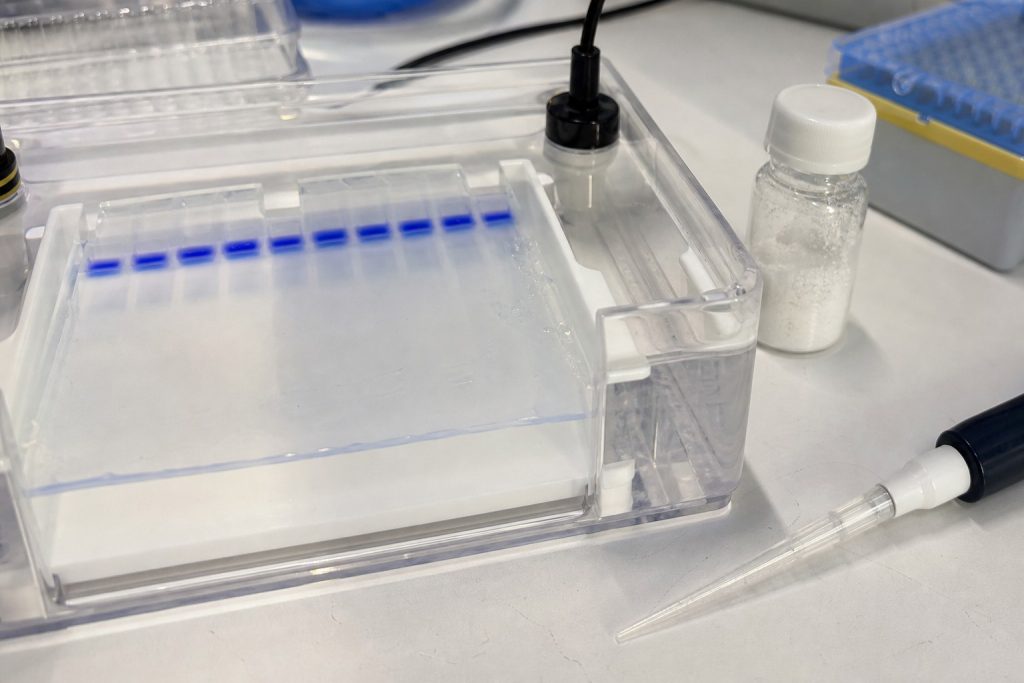
Agarose (CAS 9012-36-6) is a purified linear polysaccharide from red seaweed. Ask what is agarose, and the short laboratory answer is this: it is the material that makes an agarose gel – the clear, porous slab used in agarose gel electrophoresis to separate DNA and RNA by size. That single job explains why agarose powder sits on nearly every molecular biology bench. Beyond electrophoresis agarose, the same polymer also supports blotting workflows, immunodiffusion, chromatography beads, and specialized culture matrices.
This article focuses on applications – what agarose does in real lab work, how an electrophoresis agarose gel is chosen and prepared, and what buyers should confirm before they order molecular biology grade powder.
What Is Agarose?
Chemically, agarose is the neutral fraction of agar. It is built from repeating units of D-galactose and 3,6-anhydro-L-galactose. When the charged agaropectin fraction is removed, the remaining polymer is far better suited to nucleic acid work because residual sulfate and related charges can disturb migration.
Dry agarose is a white to off-white powder. It does not dissolve well in cold water. Heat it in electrophoresis buffer until the solution is clear, then cool it in a casting tray, and you get a thermoreversible gel. The gel sets at a lower temperature than it melts – a practical advantage during runs, because a set agarose gel stays solid at typical room-temperature electrophoresis conditions.
| CAS Number | 9012-36-6 |
| Common name | Agarose |
| Chemical class | Linear polysaccharide (agar fraction) |
| Typical form | White to off-white powder |
| Primary lab role | Matrix for agarose gel electrophoresis |
| Other frequent uses | Blotting support, immunodiffusion, chromatography beads, culture overlays |
| Documents buyers usually request | COA, TDS, SDS / MSDS |
For a deeper look at structure, EEO, melting behavior, and grade selection, see Agarose (CAS 9012-36-6): what it is, how gel electrophoresis works, and how to choose powder.
What Does Agarose Do in the Laboratory?
At the simplest level, what does agarose do? It forms a controllable porous network. That network acts as a molecular sieve. Under an electric field, charged biomolecules move through the pores at rates that depend on size, shape, and charge. For DNA and RNA, size is the main variable that labs use to interpret band patterns.
That is why people say agarose gel electrophoresis when they mean the everyday method for checking PCR products, restriction digests, plasmid preparations, and RNA integrity. The agarose gel itself is only the matrix. Buffer choice, voltage, stain, and gel concentration complete the method. Still, without a reliable electrophoresis agarose, the rest of the workflow loses resolution and reproducibility.
Core Application 1: Agarose Gel Electrophoresis of DNA and RNA
This is the dominant application of agarose (CAS 9012-36-6). An agarose gel is cast, submerged in TAE or TBE running buffer, loaded with nucleic acid samples, and run under an electric field. Smaller fragments migrate faster. After staining, bands become visible under UV or blue-light imaging.
Why labs prefer an agarose gel for routine nucleic acids
- Wide separation range for common DNA fragments (often discussed around tens of bp to about 20 kb)
- Simple casting compared with polyacrylamide for many routine sizes
- Good handling strength at practical concentrations
- Compatibility with Southern and Northern blotting workflows for larger fragments
- Low interaction with nucleic acids when purity and EEO are controlled
How gel concentration changes what you can resolve
Pore size shrinks as agarose concentration rises. A practical starting map used across teaching and research labs looks like this:
| Approximate agarose % | Typical DNA size focus (illustrative) |
| About 0.7% | Larger fragments (often discussed around ~0.8-10+ kb) |
| About 1.0% | General-purpose range (often ~0.5-7/10 kb) |
| About 1.5% | Smaller fragments (often ~0.2-3 kb) |
| About 2.0% | Very small fragments/oligos (often ~0.1-2 kb) |
These ranges are orientation tools, not absolute laws. Fragment topology, buffer system, and run conditions all matter. For very large DNA, pulsed-field methods extend what a standard agarose gel can resolve.
What low EEO means for electrophoresis agarose
Electroendosmosis (EEO) describes buffer counterflow caused by residual charged groups in the gel matrix. High EEO can distort or slow nucleic acid migration. For routine DNA and RNA work, low EEO electrophoresis agarose is usually preferred. When you source powder, ask for EEO and gel-strength values on the COA, not only a catalog name.
Core Application 2: Recovery, Blotting, and Downstream Nucleic Acid Work
Agarose is not only for viewing bands. After separation, labs cut bands from an agarose gel for purification, cloning, or sequencing prep. Low melting point (LMP) grades help when gentle melting is needed to recover heat-sensitive fragments.
Southern blotting and Northern blotting still rely on agarose gels as the first separation step for many fragment sizes, especially when fragments are larger than what acrylamide conveniently handles. In teaching labs and QC labs alike, the same powder supports both analytical checks and preparative recovery.
Core Application 3: Immunodiffusion and Related Protein Assays
Outside nucleic acids, agarose gels support classic immunological methods such as Ouchterlony double immunodiffusion and radial immunodiffusion. Antigens and antibodies diffuse through the gel and form precipitation patterns that can be read visually. Here the gel acts as a quiet, low-binding diffusion medium rather than an electrophoresis sieve – another answer to what agarose does in diagnostic and research settings.
Core Application 4: Chromatography and Beaded Agarose Matrices
Cross-linked or beaded agarose is widely used as a base matrix for protein purification methods, including size-exclusion and affinity formats. The appeal is high porosity, chemical tolerance under many buffer extremes, and relatively low non-specific binding compared with more interactive polymers. Note that chromatography beads are often a processed form of agarose, not the same SKU as electrophoresis powder – procurement should match the grade to the method.
Core Application 5: Culture Overlays, Motility, and Research Hydrogels
In microbiology and cell work, agarose sometimes replaces ordinary agar when impurities or melting behavior of agar interfere with the experiment. Examples discussed in laboratory practice include specialized overlays, plaque assays, and motility or migration setups where a controlled porous gel is required.
Research groups also evaluate agarose hydrogels as soft matrices for encapsulation and three-dimensional culture models because the polymer can hold large amounts of water and allow nutrient exchange. These are research and materials applications. They are not medical claims, and finished product or clinical use remains outside the scope of raw-material supply copy.
How to Prepare a Basic Agarose Gel (Practical Snapshot)
- Choose concentration based on the fragment sizes you need to resolve
- Weigh agarose into TAE or TBE buffer in a heat-safe flask
- Heat until fully dissolved and the solution is clear; avoid scorched residues
- Cool to a pourable temperature (often discussed around 55-65 C)
- Pour into a leveled casting tray, insert the comb, and allow full setting
- Transfer to the tank, cover with running buffer, load samples, and run
- Stain and image according to your lab’s dye and imaging SOP
Common problems and quick fixes
| Observation | Usual corrective action |
| Fragile gel | Raise agarose % or choose a higher gel-strength grade |
| Smeared bands | Check dissolution, sample integrity, voltage, and buffer freshness |
| Uneven lanes | Level the tray during casting; keep buffer coverage even |
| Weak or missing bands | Verify stain, imaging settings, and DNA load |
| Overheating during the run | Lower voltage; confirm buffer volume and tank setup |
Buying Notes for Labs and Procurement
When the search intent is B2B – research labs, distributors, or kit manufacturers – the specification sheet matters more than a generic product name. Ask suppliers for:
- CAS confirmation: 9012-36-6
- Intended grade: electrophoresis / molecular biology / LMP as needed
- EEO and gel strength on the COA
- Gelling and melting temperature ranges
- Nuclease-related purity statements where nucleic acid work requires them
- Moisture-protected packaging and lot documentation (COA, TDS, MSDS)
- Customization options for pack size or agreed specification windows
Monuo Chemical supplies research- and laboratory-grade Agarose with COA, MSDS, and formulation support.
To request documents or a quotation for Agarose (CAS 9012-36-6), contact Monuo Chem via the contact / request a quote page or email info@monuochem.com.
Frequently Asked Questions
1. What is agarose used for most often?
The most common use is agarose gel electrophoresis – casting an agarose gel to separate and analyze DNA or RNA fragments by size.
2. What does agarose do during electrophoresis?
Dissolved and cooled agarose forms a porous matrix. Under an electric field, nucleic acids migrate through those pores. Smaller fragments usually move farther in a given run, producing the familiar band pattern.
3. Is electrophoresis agarose the same as food agar?
No. Agarose is the purified neutral fraction used for molecular biology. Food or bacteriological agar still contains charged components that can interfere with clean nucleic acid separation.
4. What concentration should I use for a routine DNA check?
Many labs start near 1% agarose for everyday PCR and digest checks. Move lower for larger fragments and higher for smaller fragments. Always validate against your ladder and buffer system.
5. What is the difference between standard and low-melting-point agarose?
Standard agarose gels melt at high temperature and are excellent for routine viewing. LMP grades melt at lower temperature, which helps with fragment recovery and some in-gel enzymatic steps.
6. Where can I source Agarose CAS 9012-36-6 with documents?
Contact Monuo Chem for Agarose (CAS 9012-36-6) with COA and MSDS support.
Conclusion
So what are the applications of Agarose (CAS 9012-36-6)? First and foremost: agarose gel electrophoresis for DNA and RNA. Around that core sit blotting support, fragment recovery, immunodiffusion, beaded chromatography matrices, and specialized culture or hydrogel research uses. If you understand what agarose does – form a tunable, low-binding porous gel – every application on that list becomes easier to select, specify, and buy.
Monuo Chemical supplies research- and laboratory-grade Agarose with COA, MSDS, and formulation support.
Related Reading
- Agarose (CAS 9012-36-6): What It Is, How Gel Electrophoresis Works & How to Choose Powder
- Agarose (CAS 9012-36-6): The Essential Polysaccharide for Molecular Biology and Biotechnology
- Contact / Request a Quote – Monuo Chem
Disclaimer
Information is for laboratory raw-material education and technical reference. It is not medical advice. Experimental protocols, safety practices, and regulatory filings remain the user’s responsibility. Verify each lot against the supplied COA and SDS.