
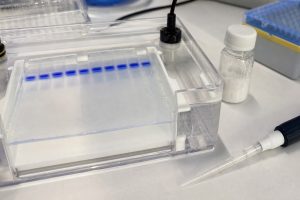

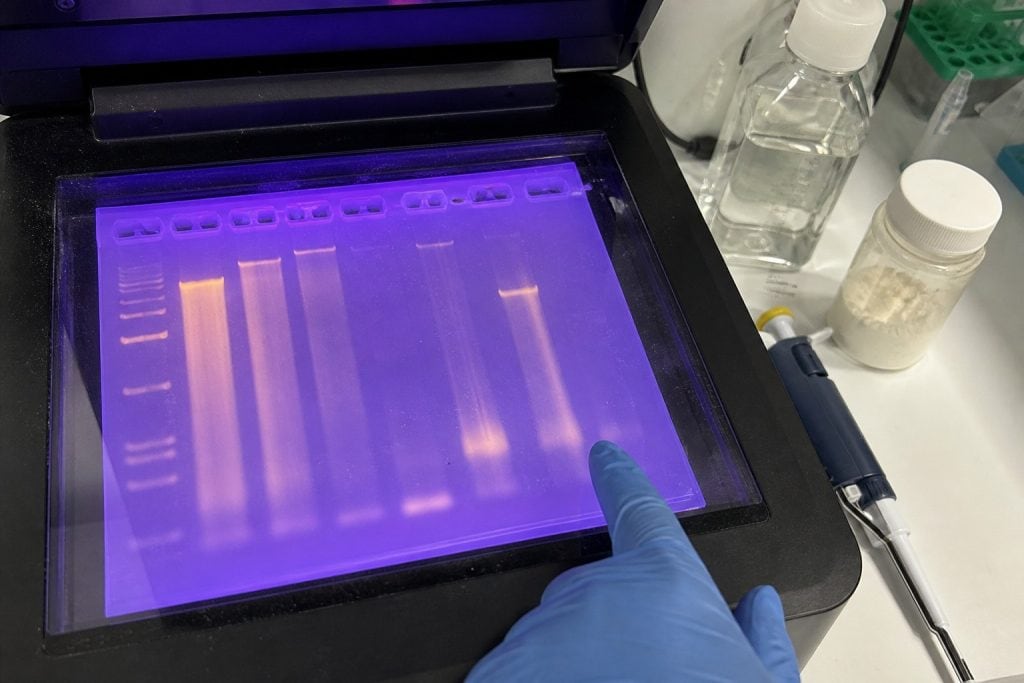
When an agarose gel looks wrong, the first question is rarely theoretical. It is practical: Why are the bands smeared? Why is the signal weak? Why is the gel soft or tearing? This guide walks through the most common failures in agarose gel electrophoresis and how to fix them when your matrix is built from electrophoresis agarose identified as CAS 9012-36-6.
Quick orientation: What is agarose? It is a neutral polysaccharide purified from red seaweed and sold as a white powder. What does agarose do? After heating in buffer and cooling, it forms a porous agarose gel that sieves DNA or RNA by size under an electric field. Most troubleshooting starts with that matrix, then moves to sample integrity, buffer, voltage, and imaging.
For supply identity and documents, see Agarose (CAS 9012-36-6) from Monuo Chem.
Start Here: Separate Matrix Problems from Sample Problems
Good troubleshooting is triage. Before you blame the powder, decide which bucket the failure belongs to:
- Matrix / casting: soft gel, bubbles, cloudy gel, uneven thickness
- Run conditions: smiling bands, melted gel, fuzzy lanes from heat
- Sample quality: smear from degraded DNA/RNA, overload, salt or protein carryover
- Detection: weak or missing bands from stain, imaging, load, or polarity
If the DNA ladder looks sharp while samples smear, look at the samples. If ladder and samples both look bad, look at the agarose gel, buffer, and voltage first.
Problem 1: Smeared Bands
Smearing is the most searched complaint in agarose gel electrophoresis. It can mean different things depending on where the smear sits.
What a smear usually means
| Pattern | Likely explanation |
| Whole-lane smear | Degraded nucleic acid; nuclease contamination; severe overload |
| Smear mainly at high MW | Salt/protein carryover; incomplete purification; overload |
| Smear with heating signs | Voltage too high; buffer depleted; gel overheating |
| Fuzzy bands + distorted wells | Incomplete agarose dissolution; soft unset gel; bubbles |
| Ladder smears too | Shared matrix/buffer/run issue rather than one bad sample |
Fixes that work most often
- Reduce load. Overloading is a classic cause of tailed or headed smears.
- Re-check sample integrity with a fresh aliquot or a clean control DNA.
- For RNA, treat RNase risk seriously – gloves, clean tips, dedicated reagents.
- Purify samples if salt, protein, or extraction debris is likely.
- Lower voltage. Many labs keep runs moderate (often discussed around ~5 V/cm) to limit heat.
- Use fresh 1x running buffer matched to the gel buffer system (TAE or TBE).
- Confirm the agarose fully dissolved before casting – cloudy gels smear easily.
If every gel from one powder lot looks worse than the previous lot, compare COA fields for EEO and gel strength, and confirm you are still using electrophoresis-grade agarose rather than a non-equivalent substitute.
Problem 2: Weak Signals or Missing Bands
A blank or nearly blank gel is frustrating because the cause can be upstream of the agarose gel itself. Still, detection and loading are where most labs recover quickly.
Checklist for weak or missing bands
- Confirm DNA/RNA was actually loaded – pipette tip errors happen.
- Increase load within a reasonable range; too little DNA simply disappears.
- Verify stain concentration and whether you pre-stain or post-stain.
- Check the imaging system: UV wavelength, blue-light settings, exposure time.
- Confirm electrode polarity – DNA migrates toward the anode.
- Ask whether bands ran off the gel during an overly long run.
- Use a fresh DNA ladder as a positive control for detection.
When the ladder is fine but samples are faint
That pattern usually points to low sample yield, failed PCR/digest, or sample left in the well. It is less often an agarose powder failure. Re-quantify the sample, reload, and keep one lane as a known-good control.
When ladder and samples are both faint
Suspect stain, imaging, or a systemic buffer/run mistake. Remake the staining solution, image a previously successful gel if available, and confirm the tank setup before remaking everything from powder.
Problem 3: Soft Gels, Tears, and Fragile Slabs
A soft agarose gel is usually a casting or grade issue. Soft gels tear during comb removal, fold when transferred, and allow samples to drift.
Common causes
- Agarose percentage too low for handling needs
- Incomplete setting time before comb removal
- Low gel-strength grade for the chosen concentration
- Excess water from incomplete dissolution / syneresis handling mistakes
- Pouring into a warm tray that delays firm setting
What to change
- Increase agarose % if fragment size still allows it (for example move from 0.7% toward 1.0%).
- Allow full set – often 20-40 minutes at room temperature for routine slabs.
- Specify higher gel strength on the COA when soft gels repeat across lots.
- Keep powder dry; moisture-caked agarose dissolves poorly and casts inconsistently.
- Level the casting tray so thickness is uniform.
If you are still choosing powder grade rather than repairing one bad run, read Agarose (CAS 9012-36-6): what it is, how gel electrophoresis works, and how to choose powder.
Problem 4: Cloudy Gels, Bubbles, and Uneven Migration
These look like cosmetic defects, but they change resolution.
- Cloudy gel: agarose not fully dissolved, or scorched residues from overheating.
- Bubbles: poured too hot/too fast, or flask not swirled to release trapped air.
- Smiling bands: gel overheating, uneven thickness, or buffer level problems.
- Wavy lanes: soft gel, buffer depletion, or salt gradients.
Practical rule: dissolve until optically clear, cool to a pourable temperature (often discussed around 55-65 C), pour on a leveled tray, and run with enough fresh buffer to cover the gel evenly.
A Fast Diagnostic Table for Busy Labs
| Symptom | First check | Next action |
| Smeared sample bands | Ladder sharpness; sample age/nuclease risk | Reduce load; purify; lower voltage; fresh buffer |
| Smeared ladder + samples | Dissolution clarity; voltage/heat; buffer age | Recast clear gel; moderate V; replace 1x buffer |
| Weak bands | Load amount; stain; imaging | Reload controls; verify stain/UV settings |
| No bands | Polarity; run time; stain present | Check anode direction; shorten run; restain |
| Soft / tearing gel | Agarose %; set time; gel strength | Raise %; wait longer; specify stronger grade |
| Bands smiling | Tank heat; gel thickness; buffer volume | Lower voltage; level cast; top up buffer |
| Sample stuck in wells | Well damage; incomplete set; dense debris | Recast; gentler loading; clarify sample |
Prevention Checklist Before the Next Cast
Most agarose gel failures are prevented with a short pre-flight list:
- Confirm powder identity: Agarose, CAS 9012-36-6, electrophoresis / molecular biology grade
- Match concentration to fragment size
- Dissolve fully to a clear solution in TAE or TBE
- Cast level, bubble-free slabs and allow complete setting
- Use fresh 1x running buffer of the same system
- Load controls: ladder + known-good sample
- Keep voltage moderate enough to avoid overheating
- Validate stain and imaging before discarding a ‘failed’ experiment
Need a broader view of lab uses beyond troubleshooting? See What are the applications of Agarose (CAS 9012-36-6)?.
When the Powder Itself Is the Variable
Not every smear is a bad lot – but lot-to-lot matrix differences are real. Ask suppliers for COA values that matter to electrophoresis agarose:
- CAS confirmation: 9012-36-6
- EEO (electroendosmosis)
- Gel strength at a stated percentage
- Gelling / melting temperature ranges
- Moisture-protected packaging notes
- Nuclease-related statements when nucleic acid integrity is critical
Monuo Chemical supplies research- and laboratory-grade Agarose with COA, MSDS, and formulation support.
Review specifications and request documents for Agarose (CAS 9012-36-6), or contact Monuo Chem.
FAQ
1. What is agarose in this troubleshooting context?
Agarose (CAS 9012-36-6) is the powder that forms the agarose gel matrix used in agarose gel electrophoresis. Troubleshooting assumes that matrix is correctly dissolved, cast, and matched to your buffer system.
2. What does agarose do when bands smear?
Agarose itself does not ‘smear’ DNA. It provides pores for migration. Smears usually come from degraded sample, overload, heat, incomplete dissolution, or buffer problems interacting with that matrix.
3. Why is my agarose gel soft?
Soft gels usually mean low percentage, incomplete setting, or a lower gel-strength grade. Increase %, wait longer, or specify higher gel strength on the purchase file.
4. How do I know if electrophoresis agarose quality is involved?
If multiple operators, fresh samples, and fresh buffer still give the same defect across casts from one lot, compare COA fields and trial a documented replacement lot of CAS 9012-36-6.
5. Where can I source documented Agarose CAS 9012-36-6?
See the Agarose (CAS 9012-36-6) product page from Monuo Chem.
Conclusion
Troubleshooting agarose gel electrophoresis is mostly disciplined diagnosis: smeared bands, weak signals, and soft gels each point to a different first check. Start with ladder-versus-sample patterns, then inspect casting, buffer, voltage, stain, and finally powder documentation for CAS 9012-36-6.
Monuo Chemical supplies research- and laboratory-grade Agarose with COA, MSDS, and formulation support.
Related Reading
- Product: Agarose (CAS 9012-36-6)
- What Are the Applications of Agarose (CAS 9012-36-6)?
- Agarose (CAS 9012-36-6): What It Is, How Gel Electrophoresis Works & How to Choose Powder
- Agarose (CAS 9012-36-6): The Essential Polysaccharide for Molecular Biology and Biotechnology
Disclaimer
Information is for laboratory education and technical reference. Protocols are illustrative and must be validated under your institutional SOP, biosafety, and EHS rules. Verify each lot against the supplied COA and SDS.