
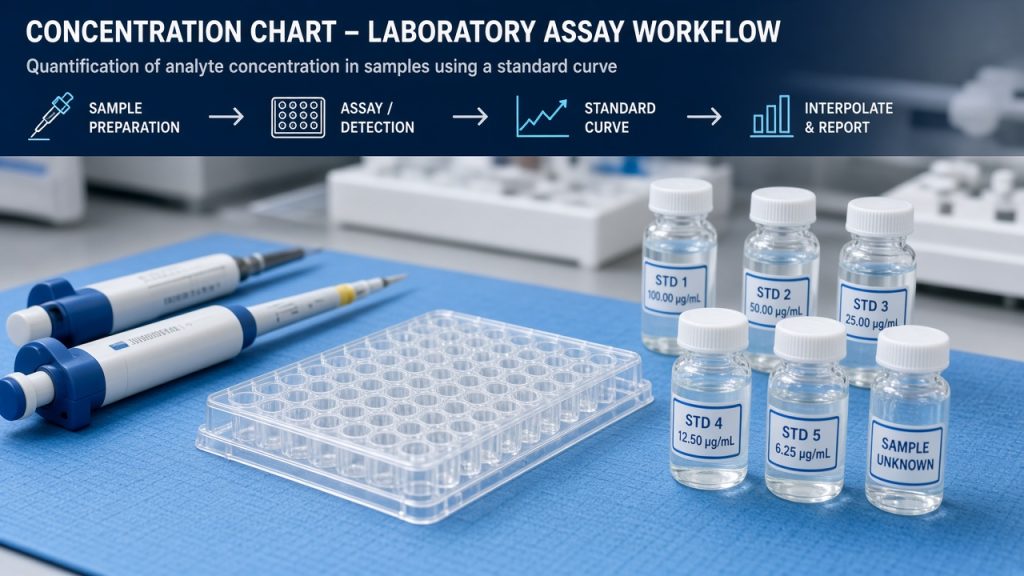
Quick Answer: Sodium taurodeoxycholate is used from roughly 0.1–10 mM in many cell and membrane assays, and up to tens of mM for protein solubilization — always above the CMC for detergent effect. Published CMC for STDC is often cited around ~1–3 mM (conditions-dependent). Tables below are literature / starting ranges; validate with your SOP.
CMC and Why It Matters
Below the critical micelle concentration (CMC), bile salts behave largely as monomers. Above CMC, they form micelles capable of solubilizing lipids and membrane fragments. Ionic strength, temperature, and pH shift CMC — do not assume a single universal number.
| Condition | Literature CMC trend for STDC | Lab action |
|---|---|---|
| Near-physiological ionic strength | Often ~1–3 mM (reported range) | Titrate around 2–5 mM for pilot |
| Lower temperature | CMC may increase slightly | Re-check solubilization at assay temp |
| Low pH | Risk of precipitation | Stay near neutral unless protocol requires acid |

Typical Concentration Ranges by Application
| Application | Literature / starting range | Comments |
|---|---|---|
| Membrane protein solubilization | 5–20 mM (method-dependent) | Optimize protein:detergent ratio empirically |
| Mitochondrial membrane prep | 1–5 mM common starting window | Combine with protease inhibitors per SOP |
| Mixed micelle reconstitution | Match lipid:detergent ratio from paper | Often 5–20 mM STDC during incorporation |
| Cell permeabilization (short pulse) | 0.1–1 mM | Cytotoxicity rises quickly — time-limit exposure |
| Signaling / bile acid biology | 10–100 µM to low mM | Assay-specific; not always micellar |
| High-concentration stock | Up to ~0.5 M aqueous (supplier solubility data) | Dilute into workflow; filter if needed |
STDC vs Sodium Taurocholate: Concentration Perspective
| Goal | STDC starting thought | Taurocholate starting thought |
|---|---|---|
| Reach micellar regime efficiently | Lower mM due to lower CMC | Somew higher mM |
| Mild permeabilization | Use lower end; watch toxicity | Often gentler at similar mM |
| Aggressive solubilization | Preferred in many membrane protocols | May need higher mM or add co-detergent |
Full comparison: STDC vs Sodium Taurocholate.
Dilution Examples From 10 mM Stock
| Final concentration | Volume of 10 mM stock per 1 mL final | Example use |
|---|---|---|
| 0.5 mM | 50 µL | Pilot permeabilization |
| 1 mM | 100 µL | Low micellar assay |
| 5 mM | 500 µL | Solubilization pilot |
Documenting Concentrations in LIMS
- Record molarity, not only mg/mL (unless SOP defines mass/volume)
- Note lot, hydrate form, and stock prep date
- Link to primary reference or internal method ID
- Flag if concentration is below CMC (may explain null results)
FAQ
What concentration solubilizes membranes?
Many protocols use ≥5 mM STDC, but optimal concentration is protein- and lipid-dependent. Titrate and monitor yield.
Is 1 mM enough?
1 mM may be near or above CMC depending on buffer — sufficient for some assays but possibly insufficient for robust membrane solubilization.
Can I use percentage (w/v) instead of mM?
Biochemistry literature prefers mM for bile salts. Convert using formula weight from COA.
Does hydrate form change mM?
The same moles of STDC require different mass if formula weight includes hydration water.
Related Resources
- How to Prepare STDC Solutions
- STDC vs Sodium Taurocholate
- Biochemistry Workflow
- Sodium Taurodeoxycholate / Taurodeoxycholic acid sodium salt (CAS 1180-95-6)
- Buying Guide
Disclaimer
This article is for research and laboratory use information only. It does not constitute medical, diagnostic, or therapeutic advice. Verify all concentrations, grades, and handling steps against your institution’s SOP, SDS, and primary literature before use in regulated or clinical-adjacent workflows.