
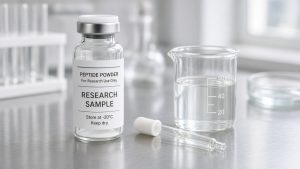
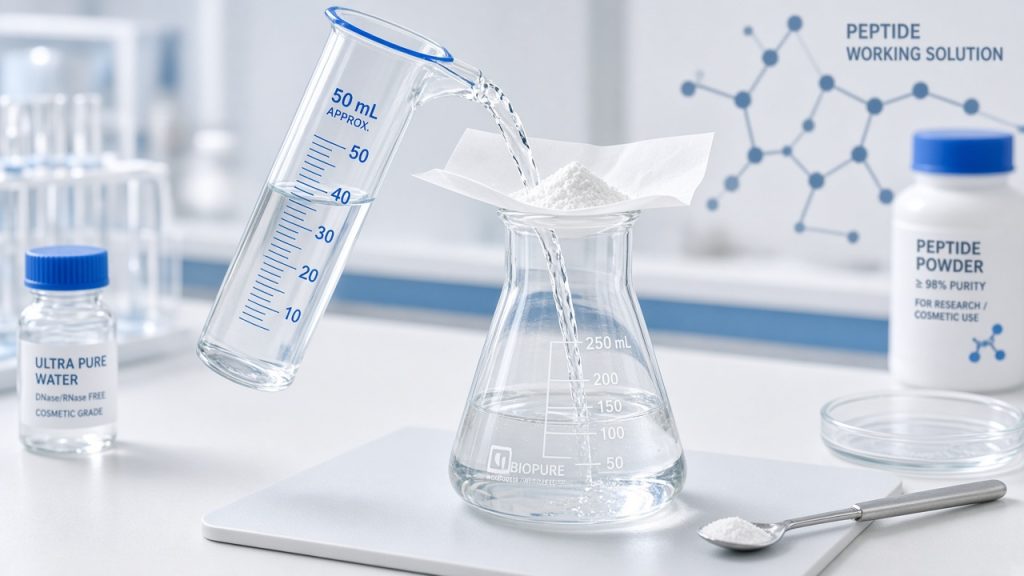
Quick Answer: To prepare a Syn-Ake working solution from Dipeptide Diaminobutyroyl Benzylamide Diacetate (CAS 823202-99-9), weigh the peptide powder or concentrate into a clean vessel, pre-wet with water or humectant, dissolve with gentle stirring (avoid high shear and heat), adjust to your documented concentration basis, filter if your SOP requires, and store refrigerated in a sealed, labeled aliquot. Always state whether concentrations are on an active peptide basis or supplier solution basis — they are not interchangeable in spreadsheets.
Before You Start: Read the COA
| COA field | Why it matters |
|---|---|
| CAS 823202-99-9 | Confirms correct material |
| Assay / purity | Drives your active-weight calculation |
| Form | Diacetate salt vs free base — affects MW in calculations |
| Recommended solvent | Water, glycerin co-solvent, etc. |
| Micro status | May dictate preservative if you bulk-dilute |
Example Lab Calculation (Illustrative Only)
Suppose your target is a 0.5% active peptide stock in water for lab use (not a finished cosmetic claim level). If COA assay is 98% and you need 100 g of stock:
| Step | Action |
|---|---|
| 1 | Calculate active needed: 0.5 g peptide active in 100 g stock |
| 2 | Correct for assay: 0.5 / 0.98 ≈ 0.51 g material to weigh |
| 3 | Pre-wet in ~10 g water; stir until clear |
| 4 | QS to 100 g; note density if using volume measures |
| 5 | Label: lot, date, basis, storage temp, retest date |
Finished product use levels are usually discussed as inclusion of a supplier solution at a few percent — see use levels by format and formulating guide.
Dissolution Tips That Reduce Batch Failures
- Use deionized water or formula-compatible humectant pre-mix.
- Avoid magnetic stirrer grinding against flask bottom for long periods.
- Do not autoclave peptide stocks.
- If using glycerin co-solvent, warm glycerin slightly to aid wetting — then cool before storage.
- For production, many teams skip in-house powder weighing and buy supplier-ready solution.
When to Filter or Sterilize
Lab R&D may use 0.22 µm filtration for small batches; production paths depend on your QMS. Heat sterilization is generally inappropriate for peptides. Document any filter adsorption risk with a small mass-balance check.
FAQ
What concentration should our working stock be?
Common lab stocks are often 0.1–1% active for pipetting convenience — choose what matches your formula spreadsheet.
Can we dissolve Syn-Ake directly in ethanol?
Peptides are usually water-first. High alcohol may precipitate or denature — follow supplier solvent guidance.
How do we convert powder to the same basis as a 0.5% commercial solution?
Match active peptide mass in the finished formula, not just volume of commercial solution.
Should working solutions be preserved?
If stored more than a few days or held above refrigeration, add a validated preservative system per your micro SOP.
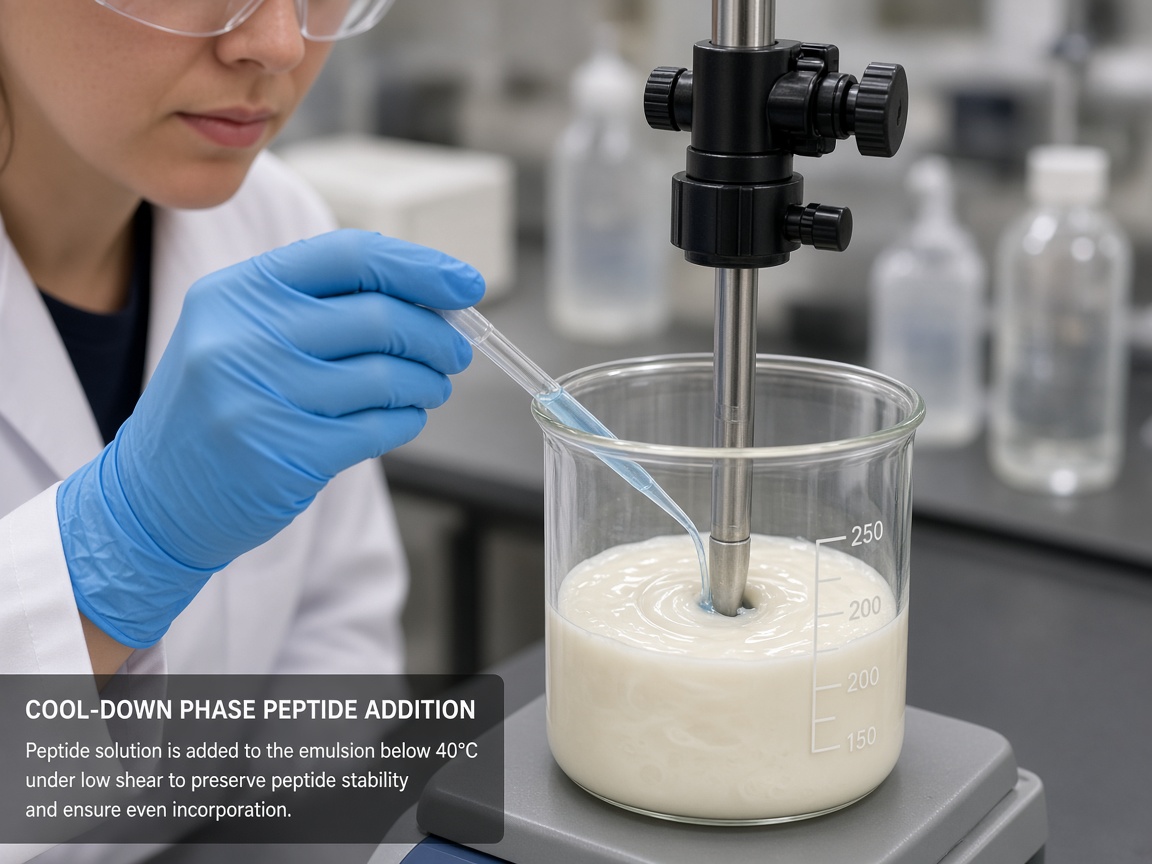
Where does this solution get added in production?
Typically cool-down below ~40 °C with slow mixing — never the hot oil phase.
Related Resources
- What is Dipeptide Diaminobutyroyl Benzylamide Diacetate (Syn-Ake)?
- The Science Behind Syn-Ake (CAS 823202-99-9)
- Formulating Syn-Ake: Use Level, pH, Cool-Down & Argireline Pairing
- Writing Honest Syn-Ake Claims Language
- Syn-Ake Manufacturing & Quality Control
- Syn-Ake in Expression-Line Cosmetics
- Dipeptide Diaminobutyroyl Benzylamide Diacetate product page (CAS 823202-99-9)
- Cosmetic peptides category
- Contact Monuo Chemical for COA / quotation
- Raw material storage & shelf life
- Compatibility matrix (HA, niacinamide, retinol)
- Emulsion troubleshooting
Disclaimer
This page is for cosmetic formulation education and B2B sourcing context. Use levels cited are typical literature or supplier-range starting points, not guaranteed recipes. Finished-product claims, labeling, and regulatory compliance remain the customer’s responsibility. Verify each lot against the supplied COA and SDS. Do not use medical, injectable, or drug claim language for topical peptide marketing.