
Quick Answer: EEO (electroendosmosis) is the bulk flow of water through the gel matrix during electrophoresis. Low-EEO agarose (often discussed around <0.13 in supplier literature) reduces counter-flow against DNA migration, helping sharper bands and more predictable separation — especially for large DNA, pulsed-field (PFGE), and some blotting workflows. Routine 100 bp–10 kb checking gels often run fine on standard electrophoresis grades of Agarose (CAS 9012-36-6); choose low-EEO when your SOP, fragment size, or COA requirements call for it.
What Is Electroendosmosis (EEO)?
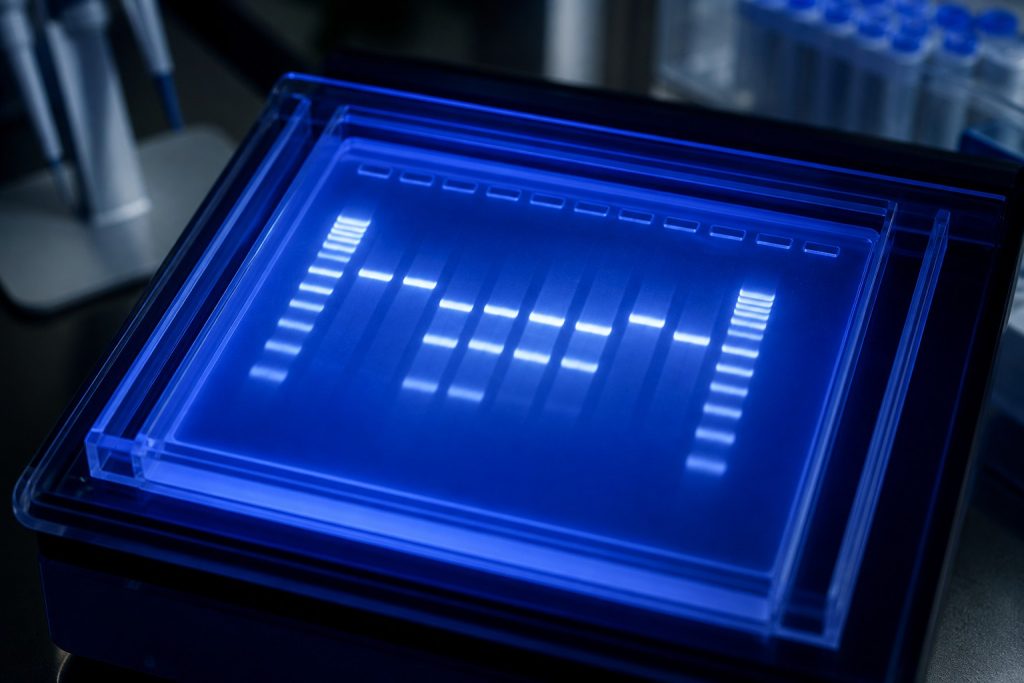
Agarose gels contain fixed negative charges (sulfate and other groups) on the matrix. In electrophoresis buffer, cations migrate toward the cathode and drag water with them — that bulk water movement is electroendosmosis. DNA migrates toward the anode; EEO creates a opposing flow that can slow, smear, or distort bands if it is too high.
For foundational context on casting and running gels, see Agarose (CAS 9012-36-6): What It Is, How Gel Electrophoresis Works & How to Choose Powder.
Low-EEO vs Standard vs High-EEO — Practical Comparison
| Grade (typical EEO discussion) | Band appearance | Common lab use |
|---|---|---|
| Low-EEO (<~0.13 in many catalogs) | Sharper; less smear on large fragments | PFGE, large DNA, some Southern/Northern setups |
| Standard / electrophoresis grade (moderate EEO) | Good for routine ladders | Daily miniprep checks, cloning screens |
| Higher-EEO / less refined grades | More drift and diffusion | Usually avoided for nucleic acid gels |
Note: EEO numbers are supplier-specific and measured under defined conditions. Always compare COA values within the same test method, not across unrelated brands.
When Low-EEO Agarose Is Worth the Upgrade
- Large DNA (>10–20 kb) where standard gels show trailing
- PFGE and other pulsed-field protocols
- Blotting workflows sensitive to band shape
- Quantitative densitometry where smear affects integration
- Core facilities standardizing one premium grade for multiple services
When standard grade is usually enough
- Routine PCR product and plasmid checks with commercial ladders
- Teaching labs running 0.8–1.2% gels in TAE/TBE
- Budget-constrained high-throughput screening
Low-EEO and Other Grade Choices (LMP, Standard)
EEO is independent of gelling temperature. Standard vs LMP Agarose explains low-melting / low-gelling grades for in-gel enzymatic work. You can need low-EEO for migration quality and LMP for recovery — confirm both on the COA when ordering.
Running Buffers and Low-EEO Gels
Buffer ionic strength affects EEO expression. TAE vs TBE for Agarose Gels notes that TBE can sharpen small-fragment separation while TAE is common for everyday gels. If you switch buffer and grade together, re-validate ladder migration before changing SOPs.
Quality Factors That Mimic “Wrong EEO”
Before upgrading grade, rule out:
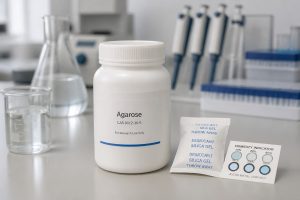
- Moisture-damaged powder — Agarose Powder Storage & Rehydration
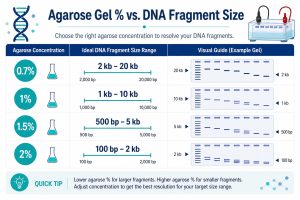
- Wrong agarose percentage for fragment size — Agarose Gel Concentration Chart
- Overloaded samples or degraded DNA
- Repeated melt–recast cycles
- Voltage / run time issues — Electrophoresis Troubleshooting
Procurement Checklist for Low-EEO Lots
| Ask for | Why it matters |
|---|---|
| EEO value + test method | Comparable specs between quotes |
| Gel strength (g/cm²) | Mechanical stability for long PFGE runs |
| DNase/RNase activity | Nucleic acid integrity |
| Moisture / storage | Dissolution consistency |
Request documentation with your quote for Agarose (CAS 9012-36-6) via Contact.
Low-EEO vs PAGE
For fragments below ~50–100 bp (lab-dependent), Agarose vs PAGE may be more appropriate than any agarose EEO tuning.
FAQ
Is lower EEO always better?
Not necessarily. Ultra-low EEO premium grades cost more and may not improve routine 100 bp–5 kb gels visibly. Match grade to application and validate with your ladder.
Can I fix high-EEO behavior with more agarose?
Increasing percentage changes pore size but does not fully replace low-EEO matrix chemistry. Use the concentration chart for pore size; use EEO grade for bulk flow control.
Does low-EEO agarose store differently?
Same dry, sealed storage as standard powder. See storage guidance for humidity control.
Related Resources
- Agarose (CAS 9012-36-6)
- Standard vs LMP Agarose
- Agarose Gel Concentration Chart
- Powder Storage & Rehydration
- TAE vs TBE
- Contact for COA / quotation
Disclaimer
EEO thresholds and product names vary by manufacturer. This article is educational; confirm grade selection with your SOP and supplier COA.