

Quick Answer: Store agarose powder (CAS 9012-36-6) in a sealed, dry container at room temperature; add desiccant if your lab is humid. Moisture causes clumping and slower dissolution. Dissolve in buffer or water with gentle heating and occasional swirling — avoid boiling over. Repeated melt–recast of the same gel or reheated stock can increase background smear and band diffusion; for critical separations, cast fresh gels from powder. When buying, request a COA and note the supplier’s storage guidance on the label.
Why Storage and Rehydration Affect Gel Quality
Agarose is a polysaccharide that absorbs water when exposed to humidity. Labs often blame “bad buffer” or “wrong voltage” when bands look fuzzy — but powder condition and dissolution practice are common root causes, especially in shared prep rooms or coastal climates.
If you are new to the material, start with Agarose (CAS 9012-36-6): What It Is, How Gel Electrophoresis Works & How to Choose Powder. This article focuses on Agarose (CAS 9012-36-6) from sealed bottle to cast gel.
Recommended Storage Conditions
| Factor | Practical guidance |
|---|---|
| Container | Original foil-lined bottle or airtight jar; close immediately after scooping |
| Temperature | 15–25 °C (room temp); avoid repeated heat cycles near autoclaves |
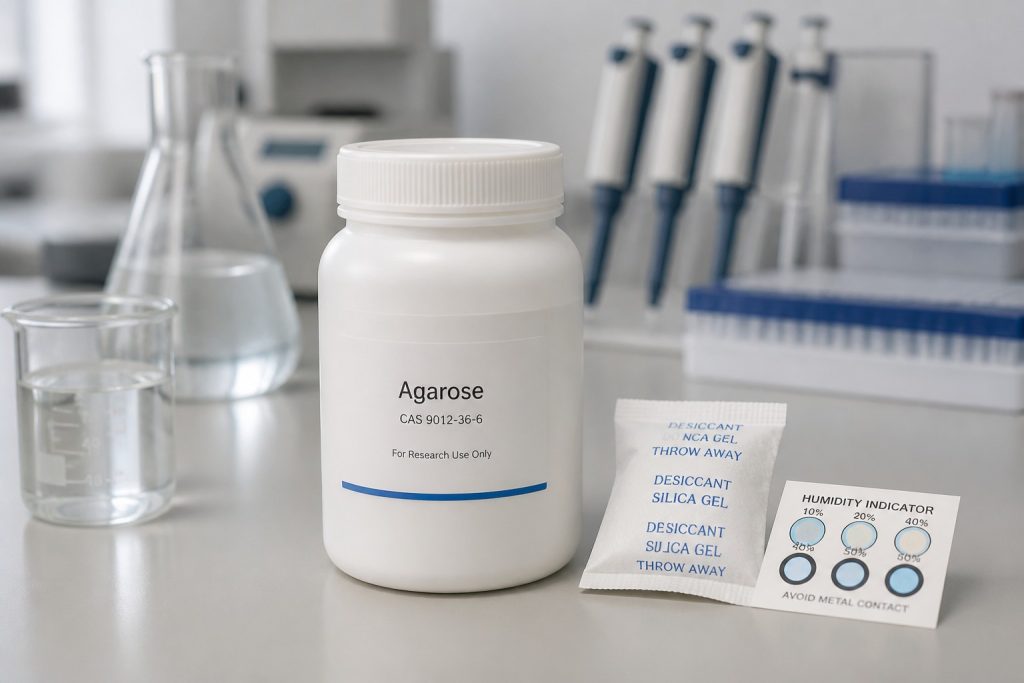
| Humidity | Keep RH low; silica gel or desiccator if clumping is recurring |
| Light | Ambient lab light is usually fine; follow supplier label |
| Shelf life | Use supplier expiry; do not rely on powder that smells off or dissolves poorly |
- Label open date on the bottle when QA requires traceability.
- Do not store open powder next to running buffers or wash stations.
- Transfer only what you need for the day if humidity is a chronic issue.
Moisture Uptake: What Goes Wrong
When agarose picks up water, grains stick together into hard or soft clumps. Clumped powder wets unevenly: the outer layer dissolves while the core stays dry, leading to particulates, hazy molten agarose, and micro-bubbles trapped in the cast gel.
Signs moisture may be the issue
- Powder no longer flows freely in the bottle
- Longer heating times to clear the solution
- Visible specks or “grit” in the gel after casting
- Increased background fluorescence after staining (see Agarose Gel Staining & Imaging)
Clumped Powder: Can You Still Use It?
For routine checking gels, many labs break up soft clumps and dissolve with extra heating and stirring. For publication-grade or quantitative work, prefer fresh, free-flowing powder.
| Situation | Suggested action |
|---|---|
| Soft clumps, occasional use | Break up; dissolve with longer gentle heat; filter if SOP allows |
| Hard cake, discoloration | Discard; replace lot; review storage |
| Shared prep room / high humidity | New desiccant; smaller aliquots; verify COA moisture specs on incoming lots |
| Critical PFGE / large fragments | Use premium grade; see Low-EEO guidance if applicable |
Dissolution (Rehydration) SOP — Lab Checklist
- Weigh agarose into a flask or bottle rated for microwave or hot-plate use.
- Add 1× TAE/TBE or water per your SOP (buffer choice: TAE vs TBE for Agarose Gels).
- Soak 5–10 min at room temperature so powder wets before heating.
- Heat in short intervals (e.g., 15–30 s microwave bursts or 60–80 °C hot plate), swirling between cycles.
- Stop when the solution is clear and no floating grains remain (do not boil dry).
- Optional: 55–60 °C water bath hold before casting; pour within your validated time window.
Repeated Heating and Melt–Recast Cycles
Re-melting a cast gel or repeatedly reheating the same molten agarose saves time in teaching labs, but each cycle can:
- Increase electroendosmosis (EEO) variability in some grades
- Promote buffer evaporation and concentration drift
- Widen bands and add smear, especially for small fragments
- Raise background after staining
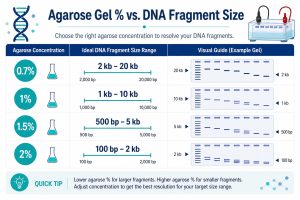
For troubleshooting smears and fuzzy bands, see Nucleic Acid Electrophoresis: Common Problems & Troubleshooting. Rule out storage and dissolution before changing agarose percentage (Agarose Gel Concentration Chart) or switching to Low-EEO Agarose Explained.
Procurement Notes for Core Facilities
- Request COA and compare gel strength / EEO if your SOP specifies a grade.
- Standard vs LMP: Standard vs LMP Agarose — LMP matters for in-gel applications, not storage alone.
- Quote packaging that matches usage (e.g., 100 g / 500 g) to limit open-bottle time.
- Align incoming inspection with how you store opened containers.
FAQ
Should agarose powder be refrigerated?
Most electrophoresis grades are stored at room temperature sealed and dry. Refrigeration can help in very humid environments if the bottle is truly airtight; allow the closed bottle to warm to room temperature before opening to reduce condensation.
How long can molten agarose sit before casting?
Follow your validated SOP. Many labs hold molten agarose at 55–60 °C for up to a few hours. If the surface skins over or the volume drops, prepare a fresh batch for critical runs.
Does clumped powder change the effective agarose percentage?
If undissolved material remains, yes — the gel may behave like a lower-percentage gel. Always confirm a clear solution before casting.
Related Resources
- Agarose (CAS 9012-36-6) product page
- Agarose Gel Staining & Imaging
- TAE vs TBE for Agarose Gels
- Standard vs LMP Agarose
- Electrophoresis troubleshooting
- Contact Monuo Chemical for COA / quotation
Disclaimer
This page is for general laboratory education and B2B sourcing context. Validate storage and dissolution steps against your institution’s SOP, supplier label, and safety requirements. Specifications vary by grade and lot.