
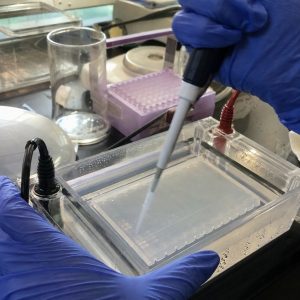

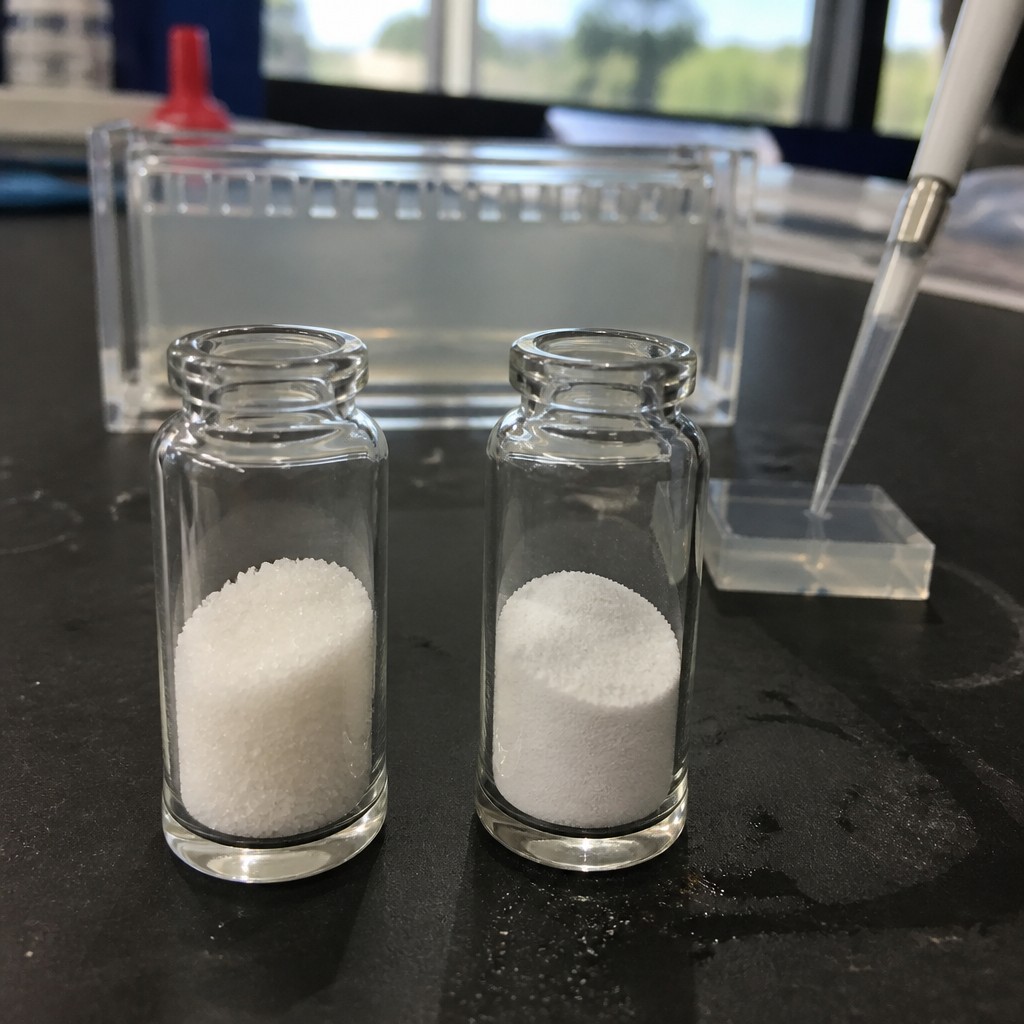
Use standard agarose (CAS 9012-36-6) for routine DNA/RNA gel electrophoresis — PCR checks, digests, teaching labs, and most analytical runs. Choose low gelling temperature / LMP-type agarose (CAS 39346-81-1) when you need gentler remelting for DNA fragment recovery, gel extraction, or in-gel enzymatic steps. They are related seaweed-derived gel matrices, but they are not interchangeable SKUs. Lock the correct CAS, thermal profile, and COA fields before you standardize a core-facility grade.
Why Labs Confuse These Two Grades
Both products make clear agarose gels and both appear in molecular biology catalogs. The practical difference is thermal behavior and downstream intent:
- Standard electrophoresis agarose is optimized as a daily casting matrix.
- Low gelling / LMP-type agarose is chemically modified (commonly hydroxyethylated) so the gel can be handled at milder temperatures for recovery and in-gel work.
For a broader primer on powder selection and electrophoresis basics, see Agarose (CAS 9012-36-6): What It Is, How Gel Electrophoresis Works & How to Choose Powder.
Side-by-Side Comparison
| Topic | Standard Agarose | LMP / Low Gelling Temperature Agarose |
| CAS Number | 9012-36-6 | 39346-81-1 |
| What it is | Neutral linear polysaccharide fraction from red seaweed agar | Modified (often hydroxyethylated) low-gelling agarose for gentler remelt workflows |
| Typical gelling behavior | Commonly discussed around ~34–42 °C (confirm lot COA/TDS) | Commonly discussed around ~26–30 °C (confirm lot COA/TDS) |
| Typical melting / remelt behavior | Higher remelt window (often discussed near ~85–95 °C for standard gels) | Lower remelt window designed for gentler recovery (confirm exact values on COA/TDS) |
| Best first use | Routine analytical electrophoresis | Fragment recovery, gel extraction, in-gel ligation/digestion concepts |
| Cost/inventory role | Usually the default high-volume SKU | Specialty SKU — stock when recovery workflows are frequent |
| Buyer identity lock | CAS 9012-36-6 + electrophoresis grade notes | CAS 39346-81-1 + low-gelling / LMP designation on COA |
Exact gelling and melting numbers vary by concentration and supplier method. Always treat the batch COA / TDS as the controlling specification.
What Standard Agarose (CAS 9012-36-6) Is Best For
Standard Agarose (CAS 9012-36-6) is the workhorse powder for most nucleic-acid gels:
- Endpoint PCR checks and amplicon sizing
- Restriction digest verification
- Teaching-lab electrophoresis
- High-throughput analytical gels where recovery is not the goal
If your method only needs “cast → run → image → discard,” standard agarose is usually the rational default for cost, handling familiarity, and inventory simplicity.
What LMP / Low Gelling Agarose (CAS 39346-81-1) Is Best For
Agarose, Low Gelling Temperature (CAS 39346-81-1) is selected when temperature-sensitive recovery or in-gel chemistry matters:
- Recovering DNA fragments from gel slices with milder remelting than standard agarose
- Gel extraction ahead of cloning, ligation, or sequencing workflows
- In-gel enzymatic steps discussed in molecular biology protocols (ligation / digestion concepts)
- Specialty separations where the protocol explicitly calls for low-melting or low-gelling agarose
Do not buy LMP only because the name sounds “premium.” If the lab never recovers bands from gels, you may be over-specifying.
Decision Guide: Which CAS Should Purchasing Order?
| Lab situation | Order this | Why |
| Daily PCR / digest gels, no fragment recovery | CAS 9012-36-6 | Standard matrix, simpler inventory |
| Frequent gel extraction/cloning pipelines | CAS 39346-81-1 (and often also keep standard stock) | Gentler remelt profile for recovery workflows |
| Teaching labs with fixed SOPs naming “standard agarose” | CAS 9012-36-6 | Match the written method |
| Protocol explicitly says LMP / low melting / low gelling agarose | CAS 39346-81-1 | Do not substitute standard powder silently |
| Core facility serving mixed users | Stock both SKUs | Prevent method drift and emergency substitutions |
Can You Substitute One for the Other?
Short answer: not as a silent swap.
- Substituting standard agarose into an LMP recovery SOP can force hotter remelt conditions and change yield/integrity expectations.
- Substituting LMP into a routine analytical SOP can change handling feel, cost, and sometimes gel mechanics — and it may violate the written method.
- If a substitution is unavoidable, treat it as a method change: re-validate casting %, band quality, and any recovery step before scaling.
Spec Checklist Before You Approve Either Quote
| Check | Standard (9012-36-6) | LMP / Low Gelling (39346-81-1) |
| CAS on COA + label | Must be 9012-36-6 | Must be 39346-81-1 |
| Grade wording | Electrophoresis / molecular biology as required | Low gelling / LMP designation present |
| Thermal data | Gelling & melting on TDS/COA | Gelling & remelt windows on TDS/COA |
| EEO / gel strength | As required by your QMS | As required by your QMS |
| Nuclease statements | If nucleic-acid integrity is critical | If recovery / in-gel work critical |
| Sample-to-bulk | Same CAS + same thermal grade | Same CAS + same thermal grade |
Need documented trial lots of either grade? Request a 5–20 g sample + COA via Request a Quote or [email protected]. State the CAS explicitly in the message.
Practical Inventory Tip for Universities and Biopharma Core Labs
Most facilities should keep standard agarose (9012-36-6) as the default high-turnover item, and reserve low-gelling agarose (39346-81-1) for recovery/specialty benches. Mixing both into one unlabeled jar is a common root cause of “the gel behaved differently this week.”
More background on agarose as a lab polysaccharide: Agarose (CAS 9012-36-6): The Essential Polysaccharide for Molecular Biology and Biotechnology.
FAQ
What is the difference between standard agarose and LMP agarose?
Standard agarose (CAS 9012-36-6) is the routine electrophoresis matrix. LMP / low gelling temperature agarose (CAS 39346-81-1) is a modified grade designed for milder remelting and recovery-oriented workflows. Confirm thermal values on each lot COA.
Is CAS 39346-81-1 the same as CAS 9012-36-6?
No. They are different purchasing identities. Use CAS 9012-36-6 for standard agarose and CAS 39346-81-1 for low gelling temperature agarose.
Which agarose should I use for DNA gel extraction?
Protocols that emphasize gentle recovery often specify LMP / low-gelling agarose (CAS 39346-81-1). If your SOP names standard agarose, follow the validated method or re-validate before switching.
Can I use LMP agarose for routine PCR gels?
Often yes, technically, but it is usually unnecessary and more expensive as a default teaching or high-volume analytical stock. Prefer standard agarose (CAS 9012-36-6) unless the protocol requires low-gelling behavior.
What should I put on the purchase order?
Write the product name, the exact CAS (9012-36-6 or 39346-81-1), required grade language, and ask for COA fields covering gelling/melting behavior, EEO/gel strength as needed, and nuclease statements when required.
Where can I source both grades?
Monuo Chemical supplies both standard Agarose (CAS 9012-36-6) and Agarose Low Gelling Temperature (CAS 39346-81-1). Contact: Request a Quote · [email protected].
Conclusion
Choose CAS 9012-36-6 when the job is routine electrophoresis. Choose CAS 39346-81-1 when the job is recovery or in-gel work that depends on low-gelling behavior. Put the CAS on the PO, match the COA, and keep the two powders physically separated in the prep room.
Request a sample + COA for the grade you need via the contact page.
Related Resources
- Agarose (CAS 9012-36-6) product page
- Agarose Low Gelling Temperature (CAS 39346-81-1) product page
- Agarose guide: what it is, gel electrophoresis, and powder selection
- Agarose as an essential polysaccharide for molecular biology
- Request a Quote / Contact Monuo Chemical
- Monuo Chemical News
Disclaimer
Information is for laboratory reagent selection and purchasing reference. Protocols are illustrative and must be validated under your institutional SOP, biosafety, and EHS rules. Verify each lot against the supplied COA and SDS. Exact gelling/melting values are method- and lot-dependent.