
Quick Answer: Use this agarose concentration chart when casting DNA gels from agarose powder (CAS 9012-36-6): 0.5–0.7% for very large fragments (>10 kb), 0.8–1.0% for general 0.5–10 kb work, 1.2–1.5% for 0.2–3 kb, and 2.0–3.0% for small PCR products down to ~50–100 bp (lab-dependent). Adjust for gel thickness, buffer, and grade (see linked cluster articles). Always run a ladder on the same gel.
Why Concentration Matters
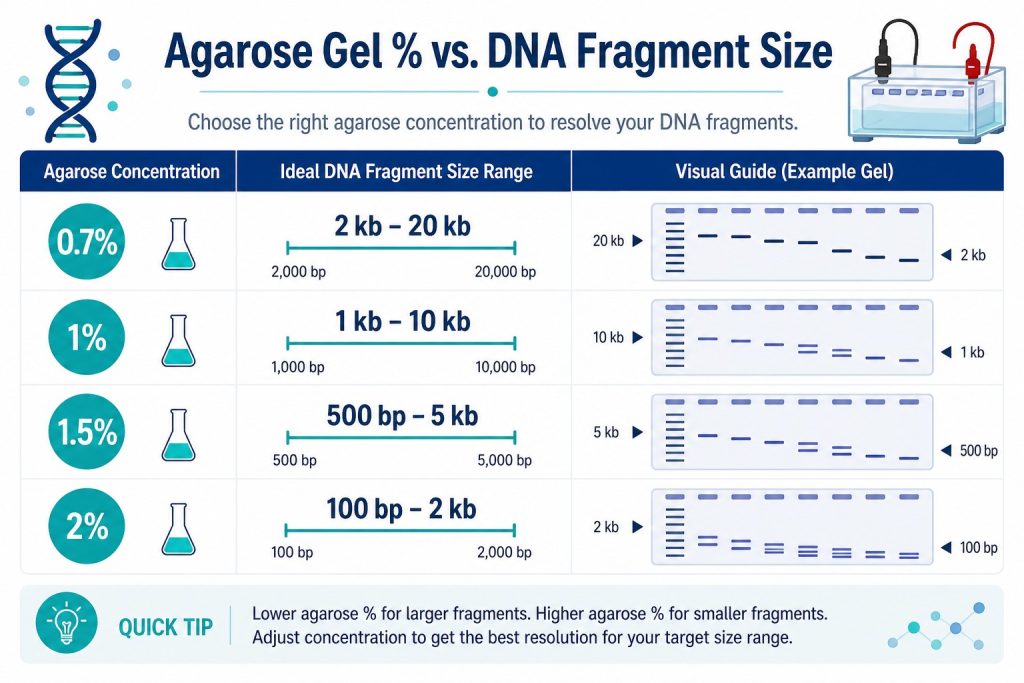
Agarose percentage sets pore size. Too low → small fragments diffuse; too high → large fragments migrate slowly and may compress. The table below is a starting point — validate with your ladder, voltage, and buffer.
New to the workflow? Read Agarose (CAS 9012-36-6): What It Is, How Gel Electrophoresis Works & How to Choose Powder and order Agarose (CAS 9012-36-6) with COA for your core facility.
Agarose Concentration vs DNA Fragment Size
| Agarose % (w/v) | Typical fragment range | Common applications |
|---|---|---|
| 0.5% | 20 kb – megabase (with PFGE) | Genomic DNA, PFGE blocks |
| 0.7% | 10–20 kb | Large plasmids, BAC fragments |
| 0.8% | 5–10 kb | Lambda, large inserts |
| 1.0% | 0.5–10 kb | General cloning, miniprep checks |
| 1.2% | 0.4–7 kb | Everyday PCR cleanup range |
| 1.5% | 0.2–3 kb | Smaller PCR products |
| 2.0% | 0.1–2 kb | Small amplicons |
| 2.5–3.0% | ~50–500 bp (lab-dependent) | Small fragment screening; consider PAGE for <100 bp |
Tip: Ranges overlap intentionally — choose the middle of the range when samples span sizes, or run two gels if you need both 100 bp and 8 kb on one lane set.
Example Formulas (100 mL Gel Volume)
Multiply grams of agarose = (percentage ÷ 100) × buffer volume (mL).
| Target % | Agarose mass per 100 mL buffer | Notes |
|---|---|---|
| 0.8% | 0.8 g | Large fragment friendly |
| 1.0% | 1.0 g | Default daily driver |
| 1.2% | 1.2 g | Slightly tighter small-band separation |
| 1.5% | 1.5 g | Small PCR products |
| 2.0% | 2.0 g | Dissolve carefully; avoid clumped powder |
Dissolution quality affects effective %. See Agarose Powder Storage & Rehydration.
Gel Thickness and Combs
- Thicker gels (higher volume in same tray) → sharper bands but longer run times
- Thin gels → faster runs; bands may diffuse if run too long
- Match comb tooth volume to sample load; overload causes smiling and smear regardless of %
- Document tray dimensions in your SOP for batch-to-batch consistency
Buffer Choice Interacts With Concentration
TAE vs TBE for Agarose Gels: TAE is common for 0.8–1.2% routine gels; TBE can improve resolution of small fragments at higher agarose %. If you change buffer, re-check ladder migration before changing your concentration SOP.
When to Tune Grade Instead of Percentage
- Large DNA smear at 0.7% → consider Low-EEO Agarose
- In-gel digestion / recovery → Standard vs LMP Agarose
- Sub-100 bp → Agarose vs PAGE may beat 3% agarose
Troubleshooting Quick Map
| Observation | Try first |
|---|---|
| All bands fuzzy | Fresh powder; correct buffer; check voltage |
| Small bands absent | Increase % to 1.5–2%; reduce run time; check degradation |
| Large bands stuck near well | Decrease % to 0.7–0.8%; use low-EEO grade |
| Smile effect | Center gel; reduce heat; balance buffer levels |
More detail: Electrophoresis Troubleshooting.
Procurement for Multi-Percentage Core Labs
- Stock one standard electrophoresis grade for 0.8–1.5% daily work
- Add low-EEO lot if PFGE / large-fragment service line exists
- Keep LMP separate for recovery workflows — not every percentage needs LMP
- Request COA and lot traceability for GMP-adjacent teaching hospitals
FAQ
Can I use 1% for everything?
1% is a workable default for many 0.5–5 kb samples, but not optimal for very large or very small fragments. Use the chart to reduce repeat runs.
Does RNA use the same percentages?
Similar logic applies, but formaldehyde or denaturing workflows differ. This chart targets native DNA agarose gels.
How do I document concentration in LIMS?
Record % w/v, buffer type, gel volume, lot number, and cast date — especially when troubleshooting band shift tickets.
Related Resources
- Agarose (CAS 9012-36-6)
- TAE vs TBE
- Low-EEO Agarose Explained
- Powder Storage & Rehydration
- Standard vs LMP Agarose
- Contact for quotation / COA
Disclaimer
Fragment ranges are approximate starting points. Validate with your ladder, instrument, and institutional SOP before releasing methods.