
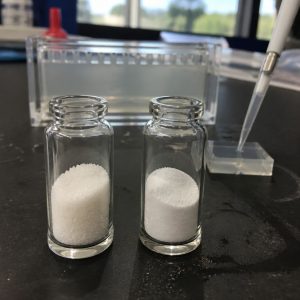

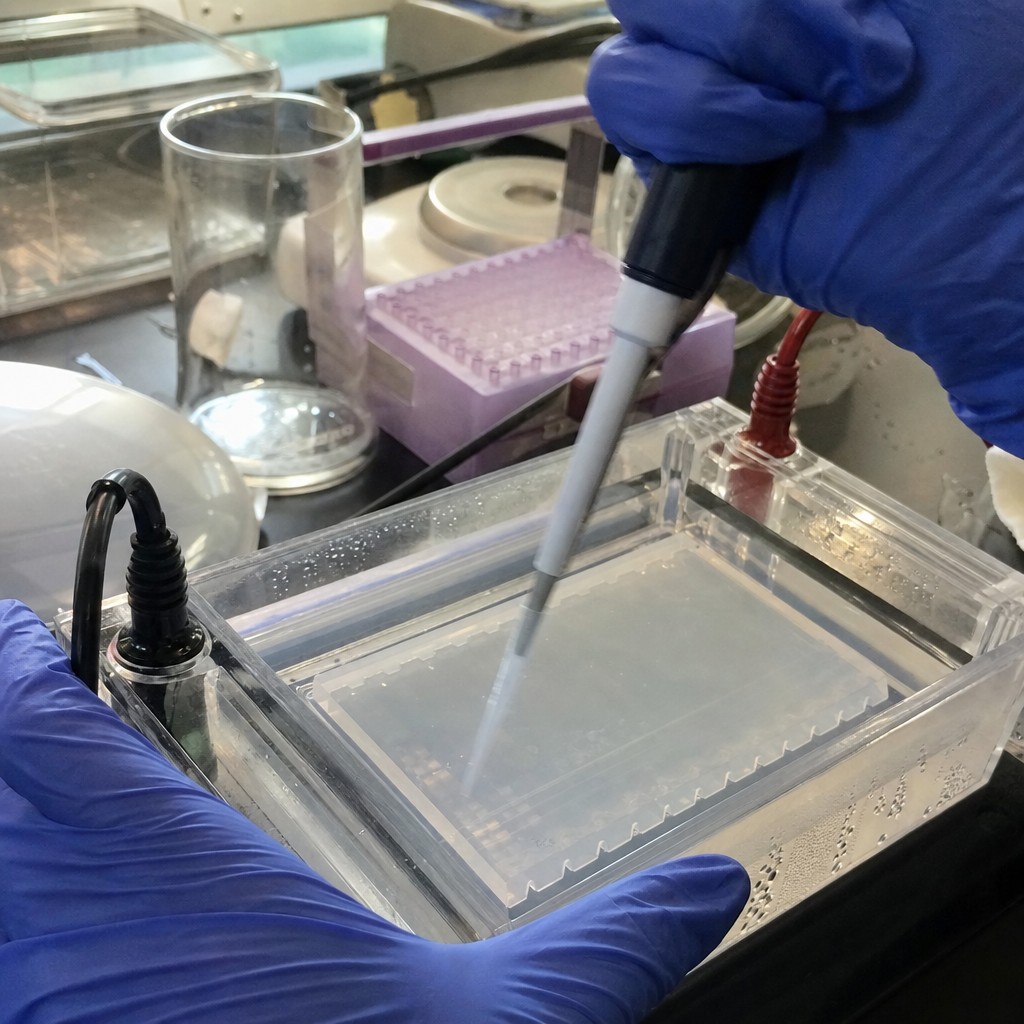
TAE (Tris-acetate-EDTA) and TBE (Tris-borate-EDTA) are the two buffer systems most labs pair with agarose powder (CAS 9012-36-6). TAE is often chosen for routine, shorter DNA gels and downstream enzymatic work. TBE is often chosen when you need stronger buffering for longer runs and sharper resolution on some separations. Neither buffer replaces correct agarose grade or concentration — write one buffer system into the SOP and keep casting buffer and running buffer matched.
Why Buffer Choice Matters as Much as Agarose Powder
Many gel failures blamed on “bad agarose” are actually buffer problems: exhausted buffering capacity, mismatched casting/running buffers, overheating, or silent switches between TAE and TBE across benches.
If you are still selecting powder grade first, start with Agarose (CAS 9012-36-6): What It Is, How Gel Electrophoresis Works & How to Choose Powder. This article answers the next decision: which buffer system to standardize.
What TAE and TBE Are
| Buffer | Full name | Core components | Lab role with agarose |
| TAE | Tris-acetate-EDTA | Tris + acetate + EDTA | Common default for routine DNA agarose gels |
| TBE | Tris-borate-EDTA | Tris + borate + EDTA | Common choice for longer / higher-resolution runs |
Both are used to dissolve and cast agarose, and to fill the electrophoresis tank. Consistency between gel buffer and running buffer matters more than brand preference.
TAE vs TBE: Side-by-Side Comparison
| Topic | TAE | TBE |
| Buffering capacity | Lower — may exhaust faster on long/hot runs | Higher — generally holds pH better during longer runs |
| Typical lab perception of migration | Often faster migration for many DNA fragments | Often slightly slower migration; can look sharper on some gels |
| Best first use case | Routine PCR checks, teaching labs, short analytical runs | Longer runs, finer resolution needs, some small-fragment work |
| Downstream enzyme friendliness (practical note) | Often preferred when DNA will go straight into enzymatic steps after gel work | Borate carryover can interfere with some downstream enzymes — plan cleanup if needed |
| Heat/voltage sensitivity | More likely to show buffer exhaustion/heating issues if over-run | Generally more robust for longer electrophoresis |
| Inventory simplicity | Excellent default if the whole building uses one system | Excellent default if methods require long runs / sharper bands |
Exact performance depends on gel %, voltage, tank design, and fragment size. Treat the table as a decision aid, then validate in your own apparatus.
When to Choose TAE
- Most daily PCR product gels
- Short teaching-lab electrophoresis modules
- Workflows where gel-purified DNA quickly enters ligation/digestion/cloning steps
- Labs that want one simple default and rarely run long gels
Pair TAE with standard Agarose (CAS 9012-36-6) for the majority of analytical casting.
When to Choose TBE
- Longer electrophoresis runs where buffer exhaustion has been a recurring issue
- Methods that need tighter band definition for the fragment range you care about
- Core facilities that already validated TBE across multiple instruments
- SOPs that explicitly specify TBE — do not silently switch to TAE mid-study
If your method later requires enzymatic processing of recovered DNA, build cleanup / buffer-exchange steps into the SOP rather than guessing at the bench.
Decision Guide for Lab Managers and Purchasing
| Situation | Standardize on | Why |
| Teaching + routine PCR verification | TAE + standard agarose | Simple, familiar, cost-effective |
| Frequent long runs/resolution complaints | TBE + standard agarose | Stronger buffering for demanding runs |
| Mixed users across a core facility | Pick ONE primary system; stock the second only for named SOPs | Prevents silent method drift |
| DNA recovery / LMP workflows | Follow the recovery SOP’s named buffer | Buffer choice is part of the validated method |
| New campus tender / multi-lab rollout | Choose one system campus-wide first | Training and QC become easier |
If your recovery methods call for low-gelling agarose, see Standard vs LMP Agarose (CAS 9012-36-6 vs 39346-81-1) — buffer choice and agarose grade are separate decisions that must both appear in the SOP.
Casting Rules That Prevent “Mystery” Gel Failures
- Match systems: Cast the gel in the same buffer family you will run (TAE gel with TAE running buffer, or TBE with TBE).
- Do not mix leftover TAE gels into a TBE tank(or the reverse) without treating it as a new method.
- Refresh running buffer on long days — exhausted buffer looks like bad agarose.
- Control heat: High voltage + weak buffering = smiling bands, soft gels, and melted edges.
- Write concentration + buffer on the gel label(example: “1.0% agarose / 1× TAE”).
How Buffer Choice Interacts with Agarose Concentration
Buffer does not replace the % agarose decision. Fragment-size windows still depend mainly on gel percentage.
| Agarose % (w/v) | Common DNA window (approx.) | Buffer note |
| 0.7% | Larger fragments | Longer runs may favor TBE buffering |
| 1.0% | General-purpose (~0.5–10 kb) | Either system works if SOP is fixed |
| 1.5–2.0% | Smaller fragments | Resolution complaints → check both % and buffer freshness |
For powder selection details beyond buffer choice, revisit the agarose powder selection guide.
What to Put in the SOP and on the RFQ
Lock these fields so every bench and every purchase order match:
- Agarose identity: CAS 9012-36-6(or LMP CAS if the method requires it)
- Gel % w/v
- Buffer system: 1× TAE or 1× TBE (state stock concentration and dilution)
- Whether casting buffer and running buffer must be identical
- Voltage/time window and maximum acceptable tank temperature
Need a documented agarose lot while you standardize buffers? Request a 5–20 g sample + COA for Agarose CAS 9012-36-6 via Request a Quote or [email protected].
FAQ
Is TAE or TBE better for agarose gel electrophoresis?
Neither is universally better. TAE is a strong default for routine short DNA gels. TBE is often preferred for longer runs and some higher-resolution needs. Standardize one system in the SOP.
Can I cast an agarose gel in TAE and run it in TBE?
It is poor practice. Mismatched casting and running buffers create avoidable variability. Keep gel and tank buffers in the same system unless a validated method says otherwise.
Does buffer choice change which agarose CAS I should buy?
Usually no for routine work — most labs still buy standard agarose CAS 9012-36-6. Buffer choice and agarose grade (standard vs LMP) are separate specifications.
Why do my bands look worse at the end of the day?
A common cause is exhausted running buffer or tank overheating, especially with lower-capacity systems on long/high-voltage runs. Refresh the buffer and re-check voltage/heat before changing agarose brands.
Should universities force one buffer campus-wide?
Yes, if teaching and shared cores want comparable results. One primary system reduces training errors. Keep the alternate buffer only for named research SOPs.
Where can I source electrophoresis agarose to pair with TAE or TBE?
Monuo Chemical supplies standard Agarose (CAS 9012-36-6) and low gelling temperature agarose (CAS 39346-81-1). Contact: Request a Quote · [email protected].
Conclusion
Pick TAE for routine short agarose gels; pick TBE when longer buffering and resolution needs dominate. Then freeze the choice in the SOP next to agarose CAS, gel %, and voltage limits. Consistent buffer discipline usually improves gels faster than switching powder brands.
Request a 5–20 g sample + COA of Agarose (CAS 9012-36-6) while you lock the buffer standard via the contact page.
Related Resources
- Agarose (CAS 9012-36-6) product page
- Agarose Low Gelling Temperature (CAS 39346-81-1) product page
- Agarose guide: electrophoresis and powder selection
- Standard vs LMP Agarose comparison
- Agarose essential polysaccharide overview
- Request a Quote / Contact Monuo Chemical
- Monuo Chemical News
Disclaimer
Information is for laboratory method selection and purchasing reference. Protocols are illustrative and must be validated under your institutional SOP, biosafety, and EHS rules. Verify agarose lots against the supplied COA and SDS.